Detecting and Preventing Attendance Irregularities Before They Happen
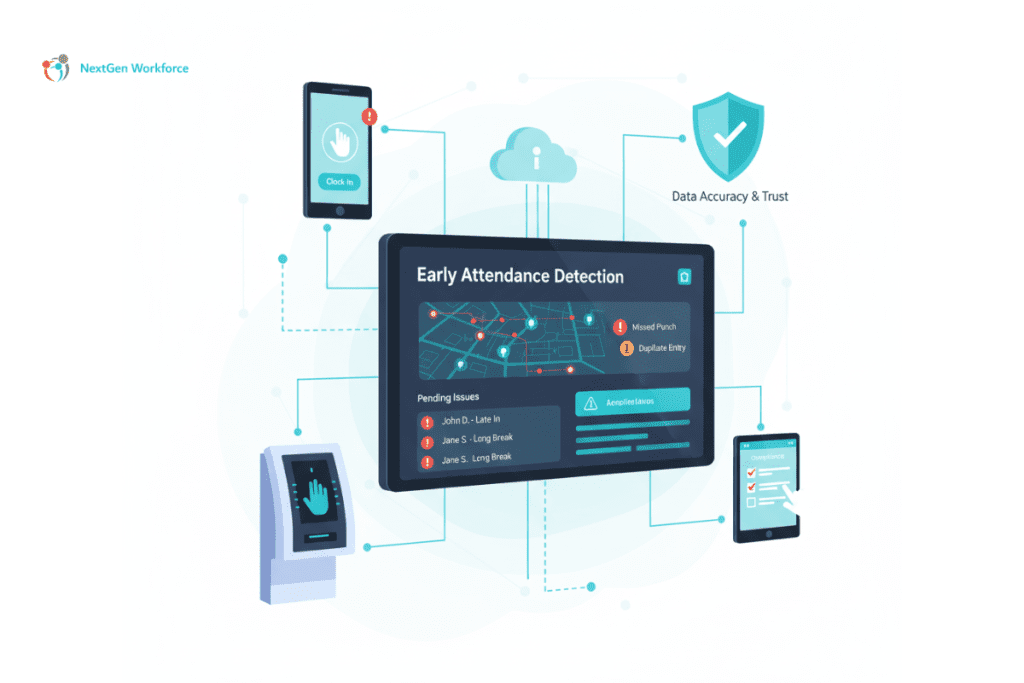
In today’s dynamic workplaces, where employees clock in from offices, job sites, and even mobile devices, tracking attendance has become both easier and more complex. Technology has made it simple to record time, but it has also introduced new challenges: duplicate entries, missed punches, buddy punching, and forgotten check-outs. These small inconsistencies may seem harmless at first, but over time, they can lead to payroll discrepancies, compliance risks, and unfair work reporting. The good news? These issues don’t have to reach the point of correction or penalty. With intelligent time-tracking and proactive systems like NextGen Workforce, organizations can detect and prevent attendance irregularities before they occur. Why Attendance Irregularities Matter Attendance data isn’t just about punctuality; it affects pay accuracy, compliance, and trust. Even minor errors, when multiplied across hundreds of employees and multiple pay cycles, can create: Payroll disputes between employees and HR. Compliance issues under labor laws. Skewed productivity insights for management. Distrust within teams when records feel inaccurate. Most companies react to irregularities after the fact, correcting missed punches, investigating duplicates, or adjusting timecards. But reactive corrections drain HR time and disrupt payroll schedules. That’s why the smartest organizations are moving from correction to prevention. Understanding Common Attendance Irregularities Before we discuss prevention, let’s look at the most frequent types of attendance issues businesses face: 1. Missed Punches Employees forget to clock in or out, often during shift changes, breaks, or remote work. 2. Buddy Punching A co-worker clocks in for someone else, intentionally or accidentally, resulting in false attendance. 3. Early or Late Clock-Ins Without defined rules, employees may clock in early or late, affecting overtime calculations and compliance. 4. Duplicate or Overlapping Entries Manual entries or system errors can record two attendance events for the same period. 5. Time Drift in Remote Environments In hybrid settings, time mismatches occur due to device errors, time zone differences, or offline punches syncing later. Each of these challenges costs businesses accuracy and credibility. The Shift: From Manual Checks to Predictive Detection Traditional attendance systems rely on manual oversight, with managers reviewing timecards, approving shifts, and fixing errors. But with larger, distributed teams, manual supervision isn’t scalable. That’s why modern systems like NextGen Workforce are built on intelligent automation, identifying and addressing anomalies before they disrupt payroll or compliance. Here’s how: 1. Smart Validation Rules: The First Line of Defense NextGen Workforce automatically applies validation rules at the point of clock-in and clock-out. For example: If an employee tries to clock in outside their scheduled location or time window, the system prompts for verification. If a duplicate punch is detected, it’s flagged immediately. If a clock-out is missing after a shift, the system can create a clock-out based on the shift clock-out time. These automated checks create a self-correcting ecosystem for issues rather than being fixed later. Result: Cleaner records, less manual intervention, and a more reliable attendance history. 2. Geolocation and Geofencing: Preventing Misuse For mobile or field-based teams, location-based validation plays a key role in attendance integrity. With NextGen’s geofencing capabilities: Clock-ins are only accepted within pre-approved work zones. Remote punches automatically record GPS coordinates at the time of entry. Managers receive location summaries for accountability without constant oversight. Know more about Geolocation and geofencing. This ensures attendance is both authentic and transparent, especially for distributed workforces. 3. Real-Time Alerts for Anomalies NextGen’s alert system acts as an early-warning mechanism. When irregularities occur, such as repeated late punches, missed check-outs, or abnormal work durations, the system notifies managers in real time. These alerts are configurable, meaning organizations can set thresholds based on their own policies or compliance requirements. Example:If an employee exceeds their daily shift hours or clocks in before an authorized start time, HR and managers get an immediate notification, allowing proactive discussion instead of retroactive correction. 4. Predictive Insights Using Attendance Patterns Over time, data tells a story, and NextGen listens. The platform analyzes attendance trends to identify potential issues before they surface. For instance: Frequent missed punches from a specific site may indicate a training gap or poor network coverage. Consistent early departures from a department may reveal a workload imbalance. Regular overtime patterns might flag potential burnout or policy misalignment. Instead of penalizing, these insights empower HR leaders to understand the “why” behind irregularities and address the root cause. 5. Integration with Scheduling and Payroll Irregularities often arise when systems don’t talk to each other. NextGen eliminates that gap by synchronizing attendance data with: Scheduling tools (so attendance aligns with assigned shifts). Payroll systems (so pay is calculated from verified data only). That means no double-entry, no mismatched records, and no late payroll corrections. Know More: Scheduling Tool By integrating scheduling, attendance, and payroll, organizations gain a single source of truth accuracy that scales. 6. Transparent Access for Employees Transparency builds trust, and trust prevents manipulation. With NextGen Workforce, employees can: View their daily punches and total hours in real time. Request corrections or explanations through the system. Receive alerts for missed punches or potential errors. This shared visibility makes employees active participants in maintaining accuracy. When everyone sees the same data, accountability becomes a shared value not a top-down control. 7. Data Security and Compliance: Preventing Internal & External Risks Detecting irregularities isn’t just about attendance behavior; it’s also about data integrity. NextGen ensures attendance data remains tamper-proof through: AES-256 encryption for all records. Audit trails that log every modification with timestamps. Role-based access control so only authorized users can view or edit data. Read more: Why Security Matters in Time-Tracking In industries where compliance and audits are critical, this level of data integrity protects organizations from both human error and regulatory penalties. 8. Education and Shared Responsibility Technology alone can’t prevent every issue; culture plays an equal role. NextGen encourages clients to take a shared responsibility approach, educating teams on attendance accuracy and compliance importance. HR teams are guided to: Reinforce attendance policies consistently. Use analytics to coach, not penalize. Recognize employees who maintain consistent, accurate records. When employees understand the
Building a Culture of Productivity (Not Just Presence): Measuring What Matters
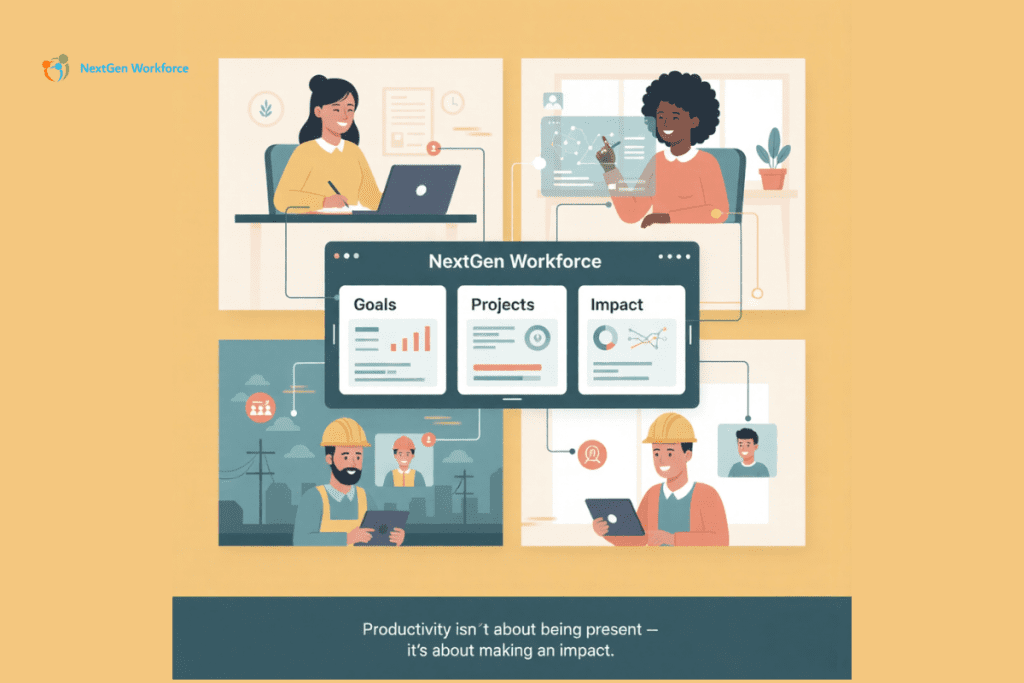
If there’s one lesson organizations have learned from hybrid and remote work, it’s that being at work doesn’t always mean working effectively. For decades, companies measured performance by the presence of those who showed up, who clocked in early, and who stayed late. But as work becomes more flexible and outcome-driven, leaders are realizing that productivity isn’t about hours on-site; it’s about the value created during those hours. And that’s where smarter, transparent systems like NextGen Workforce help organizations shift from tracking attendance to understanding impact, building a true culture of productivity. From Time Spent to Value Delivered In the traditional workplace, time was the simplest performance metric. Employees who logged the most hours were often viewed as the most committed. But as teams went hybrid and remote, that equation no longer held true. Now, two realities exist side by side: An employee might be online all day yet deliver little meaningful output. Another might work flexible hours and still exceed goals. This disconnect has pushed HR leaders and managers to ask a bigger question: how do we measure what really matters? The answer lies not in surveillance, but in visibility, accountability, and purpose. Why “Presence” Metrics Fall Short Focusing solely on attendance or login hours can unintentionally create a culture of visibility over value. Employees may start optimizing for being seen rather than for achieving outcomes. Consider this: A salesperson who hits targets while working flexible hours is often more valuable than one who’s consistently “available” but misses quotas. A designer may do their best work in bursts of focus, not in continuous online presence. NextGen Workforce helps leaders see beyond surface-level metrics by blending attendance insights with performance-oriented data. This allows organizations to recognize contribution, not just compliance. The Role of Smart Time Tracking in Modern Productivity Let’s be clear, tracking time still matters. But how we interpret that data is what makes the difference. Modern attendance systems like NextGen Workforce aren’t about monitoring; they’re about measuring meaningfully. They provide: Contextual visibility: When, where, and how employees work without invading privacy. Patterns and trends: Helping managers spot early signs of burnout or understaffing. Outcome alignment: Linking attendance data with projects, roles, and deliverables. Instead of using time tracking to enforce control, NextGen helps organizations use it as a mirror reflecting productivity, engagement, and balance. Designing a Culture That Values Output Over Optics Creating a productivity-driven culture doesn’t happen by accident; it’s intentional. Here are the principles successful organizations follow: 1. Set Clear Goals and Outcomes Employees can’t focus on what matters if expectations are vague. NextGen integrates project-level time tracking and scheduling so that every logged hour ties back to a measurable objective. When teams understand how their time contributes to business outcomes, motivation naturally increases. 2. Encourage Autonomy, Not Attendance Anxiety Micromanagement is productivity’s biggest enemy. Instead of tracking every click or minute, NextGen empowers employees with self-service visibility; they can view their time records, verify accuracy, and request corrections independently. That transparency builds trust and eliminates the “always-on” pressure. 3. Recognize Effort and Impact Equally True productivity is a mix of both effort and outcome. NextGen’s analytics dashboards help managers understand how time is spent across projects, recognizing not just who delivered results, but who contributed meaningfully along the way. 4. Use Data to Drive Fairness Bias can creep in when performance is judged subjectively. Time data, when interpreted thoughtfully, provides a factual baseline that supports fair evaluation and equitable recognition. How NextGen Helps Redefine Productivity 1. Holistic Visibility Without Micromanagement NextGen combines time tracking, scheduling, and project data in one unified view. Managers get a clear sense of how time translates into output without needing invasive tools or constant check-ins. For example: HR can identify teams regularly exceeding safe working hours and initiate support before burnout sets in. Managers can compare planned schedules versus actual outcomes to adjust workloads fairly. The focus shifts from “who’s online” to “who’s thriving.” 2. Data That Empowers, Not Polices NextGen’s reports don’t just show hours worked; they show patterns of productivity. By connecting attendance records to project codes, milestones, and pay periods, organizations can analyze: Which roles deliver the most value per hour worked? Where inefficiencies or bottlenecks occur. How scheduling decisions affect performance and morale. This empowers HR to design smarter staffing models and work policies that enhance, not restrict, productivity. 3. Real-Time Insights for Smarter Decisions NextGen’s analytics dashboard gives leaders real-time visibility into workforce behavior. Instead of waiting for end-of-month reports, managers can see trends as they develop: Who is consistently working overtime? Which projects consume the most time versus expected timelines? How hybrid or remote teams are distributing effort. That immediate visibility helps managers make proactive adjustments, ensuring work is balanced, fair, and aligned with company goals. Linking Productivity With Employee Well-being Here’s the truth: true productivity can’t exist without balance. When employees feel overworked, unseen, or micromanaged, output suffers. NextGen Workforce supports well-being through: Automatic break tracking to ensure rest periods. Smart alerts for extended work hours. Transparency tools that allow employees to review and correct their own records. By embedding these features, NextGen encourages a culture of responsibility without rigidity, where accountability supports well-being, not stress. The Shift from Monitoring to Mentoring The most forward-thinking organizations are no longer using attendance tools to monitor; they’re using them to mentor. Data from systems like NextGen helps leaders coach employees, optimize scheduling, and celebrate consistent performance. For example: If data shows a team consistently delivering ahead of schedule, leaders can replicate their processes across departments. If an employee’s working hours steadily increase, it may indicate dedication or burnout. Data gives managers the insight to have supportive conversations early. This is what a mature productivity culture looks like: data-driven empathy. Practical Tips for HR Leaders If you’re looking to move your organization from presence-based tracking to productivity-driven management, here’s where to start: Audit your metrics: Are you measuring attendance or impact? Communicate clearly: Explain how data helps employees, not just the company. Align with purpose:
Global Workforces, Diverse Regulations: Designing Attendance Systems That Scale
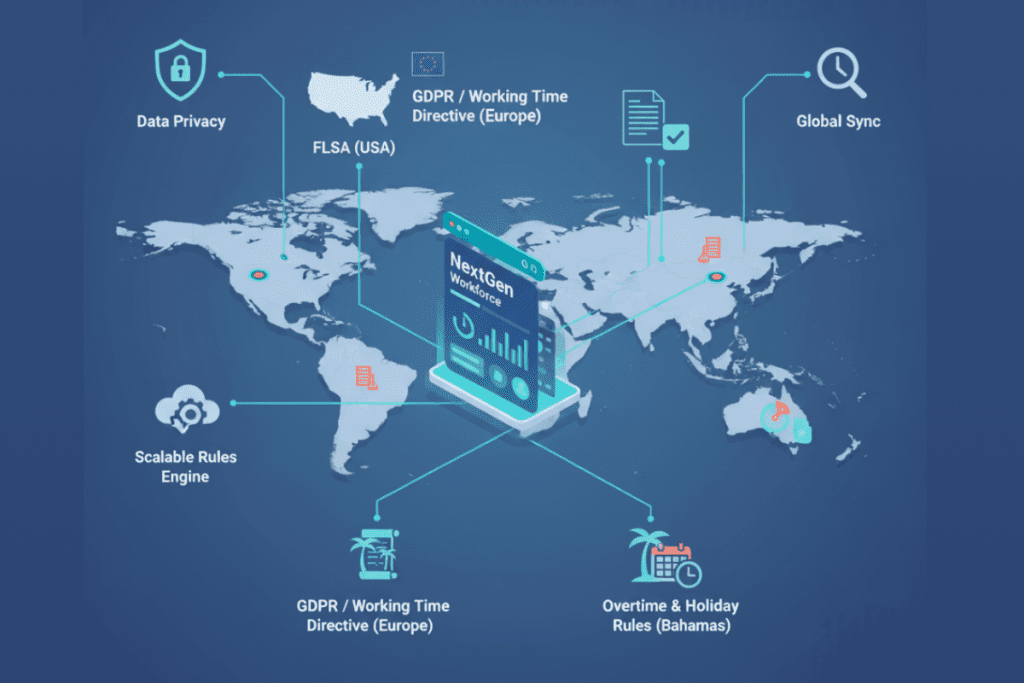
Managing employee attendance might seem straightforward until your workforce goes global. A small business in California can track hours easily enough. But when that same company grows across Europe, Asia, or the Caribbean, it faces a new reality: different labor laws, different pay cycles, and different definitions of compliance. From weekly overtime in the U.S. to strict working hour limits in Germany, from data privacy requirements in the EU to daily punch validations in the Bahamas, the challenge isn’t just about collecting time. It’s about collecting it accurately, securely, and legally across multiple jurisdictions. That’s where NextGen Workforce steps in. Built for scale and flexibility, it’s not just a time tracking system; it’s a compliance-aware platform that helps organizations manage attendance confidently across borders. Why Global Expansion Complicates Time Tracking When teams are spread across continents, managing attendance becomes more than an administrative task; it becomes a legal responsibility. Each country defines time, work hours, and employee rights differently. For example: U.S. employers must track weekly overtime beyond 40 hours under the Fair Labor Standards Act (FLSA). In Europe, the Working Time Directive limits total weekly hours and mandates rest periods. In India, regional labor laws require specific recordkeeping for contract workers. In the Bahamas, regulations demand clear visibility into overtime, holidays, and double-time pay. Visit NextGen Workforce > resources > Compliance This patchwork of laws means that what’s compliant in one region may be non-compliant in another. A global attendance system must therefore be Flexible enough to adapt to regional rules. Consistent enough to give HR a single view of time. Transparent enough to withstand audits anywhere. NextGen Workforce was designed with exactly this complexity in mind. The Foundation: Designing for Flexibility and Scale Traditional time tracking systems often assume a single set of labor rules, usually domestic ones. But scaling globally demands a different mindset. NextGen Workforce approaches time tracking as a configurable framework, not a rigid process. Customizable Rules by Country or Location Each organization can define its own: Overtime thresholds (e.g., daily or weekly). Break and rest period rules. Holiday and double-time pay settings. Localized pay period cycles (weekly, biweekly, monthly). For example, a retail team in the U.S. can track overtime weekly, while a logistics team in Germany follows daily hour caps, all within the same unified platform. This flexibility ensures local compliance without losing global visibility. Data Privacy Across Borders Beyond labor rules, data protection laws differ dramatically across regions. The EU’s GDPR, California’s CCPA, and Singapore’s PDPA all place strict requirements on how employee information like names, punch times, and locations can be collected and stored. NextGen Workforce ensures compliance by embedding privacy-by-design principles into every layer: Data localization: Each client’s data can be hosted within their chosen region, respecting local data residency rules. Limited data capture: Geolocation data is only collected during check-in/out, never as continuous tracking. Encryption and access control: All attendance data is encrypted and accessible only to authorized managers. Transparency: Employees can view and verify their own attendance data anytime through the mobile app or web portal. This commitment to privacy builds not just compliance but trust, a critical foundation for any global employer. Simplifying Multi-Country Operations As organizations expand, HR teams often struggle with disconnected systems: one for payroll in the U.S., another for scheduling in Europe, and another for attendance in Asia. NextGen Workforce solves this fragmentation by connecting attendance, scheduling, and payroll data into one ecosystem. Unified View of Global Attendance HR managers can view attendance across all sites and subsidiaries in real time without toggling between systems. Regional dashboards show trends by country, department, or site. Global reports aggregate total hours, overtime, and absences. Local managers retain control over their own settings and approvals. This combination of centralized insight with decentralized control is what makes scaling sustainable. Seamless Integration with HR and Payroll Platforms NextGen integrates effortlessly with leading systems like BambooHR, QuickBooks, and other regional payroll providers, ensuring that hours flow automatically into the right payroll system with the right local calculations. That means no duplicate data entry, no mismatched totals, and no compliance gaps between HR and payroll. Addressing Cultural and Operational Differences Scaling globally isn’t only about compliance; it’s about understanding how people work. A time tracking solution should respect both cultural norms and operational realities: In Europe, employees often prefer transparency and self-service access to their hours. In North America, mobile-first attendance and project-based tracking are essential for field teams. In Asia, hierarchical approval workflows are common, requiring flexible role-based permissions. NextGen Workforce supports all these models through: Configurable approval flows. Multi-language user interfaces. Local time zone support for global collaboration. It adapts to the way teams work instead of forcing everyone to work the same way. Compliance That Scales With You Compliance isn’t a one-time project; it’s an ongoing journey. NextGen Workforce continuously updates its platform to align with evolving global regulations. Whether it’s a change in overtime law, a new data privacy guideline, or a region-specific tax code, clients benefit from built-in updates and audit readiness. Key Compliance Capabilities: Automated audit trails: The system logs and timestamps every edit, approval, or correction. Policy alerts: Notifications for exceeded work hours or missed breaks based on local laws. Report templates: Ready-to-use compliance reports for inspections and labor audits. Retention management: Automated data retention and deletion policies configurable by region. With these tools, HR and legal teams gain peace of mind that their time tracking system evolves alongside their compliance needs. Real-World Example: A Global Hospitality Brand A leading hospitality group using NextGen operates in five countries: the U.S., the Bahamas, the U.K., Germany, and Singapore. Each region follows different labor rules, shift patterns, and pay structures. Yet, through NextGen Workforce: Managers create location-specific shift templates. Employees use the mobile app to clock in/out in compliance with local laws. Data from all regions syncs to a single dashboard for global reporting. Approved hours feed automatically into regional payroll systems. The result: 99% accuracy in attendance data. Full compliance with country-specific labor
Why Security Matters in Time Tracking: NextGen’s Commitment to Privacy and Trust
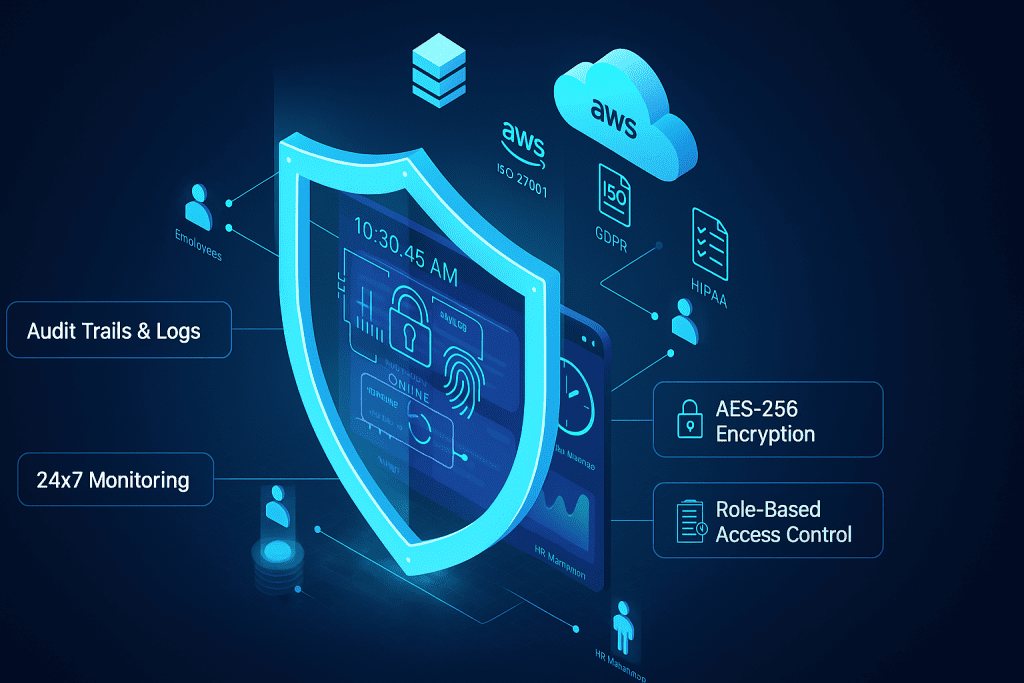
Time tracking records attendance and creates a digital employee history in modern workplaces. Modern time and attendance systems process names, employee IDs, IP addresses, geolocation information, and, in certain situations, biometric identifiers. Data now traverses many devices, networks, and locations due to hybrid and mobile work expansion, increasing exposure and compliance duties. A data breach can lead to decreased trust among employees and legal repercussions under the CCPA or GDPR. At NextGen Workforce, we consider security to be fundamental rather than optional. A security framework designed to the highest international standards safeguards each time entry, punch log, and attendance record. Built on a Secure, Compliant Cloud Infrastructure We founded our architecture on security. NextGen Workforce builds on ISO 27001-, SOC 2-, and GDPR-certified AWS industry-leading cloud infrastructure. These standards will ensure resilience and secure data at every level. The major aspects of our security framework are Encryption: We encrypt all data using AES-256 at rest and TLS 1.3 in transit, thus rendering all sensitive information unreadable. Role-based Access Control: We enable role-based access control and multi-factor authentication (MFA) in order to ensure that only authorized users can access vital data. Audit Trails: The system logs all changes in detailed activity logs, which allow detecting anomalies and provide transparency. Data Segregation: Data of respective clients exist on isolated environments, which ensures complete isolation of organizations. Security at NextGen is not added to the product after its development has been completed. Compliance and Transparency You Can Trust To HR and compliance officers, the selection of a time-tracking partner implies an evaluation of vendor risk. NextGen is fully confident as it is aligned with the strict compliance standards. Compliance standards: General Data Protection Regulation (GDPR). SOC 2 Type II HIPAA (where applicable) We apply understandable data retention and deletion policies. Clients will be able to observe the presence of dates of time data remains active and when it gets deleted. The employees have the right to all their data, which includes: Right to Access: They will be able to see their recorded time and other associated information. Right to Erasure: They may request the deletion upon termination of employment, in accordance with the law and corporate policy. Above all, NextGen ensures that there will be no data reuse among employees. The attendance records do not use analysis in the manner that may point back to individuals. NextGen offers organizations insight, regulation, and articulateness of workforce data. Balancing Accountability with Employee Privacy Security isn’t just about firewalls and encryption; it’s about respect. NextGen builds on a privacy-by-design philosophy, ensuring that every feature serves a legitimate purpose in attendance management and compliance. Limited Data Capture: The system restricts location tracking to check-in and check-out events, not continuous monitoring. Clear Communication: Employers inform employees about what they are tracking and why, promoting trust and transparency. Legitimate Purpose: We collect data only for lawful and operational needs like payroll accuracy, compliance, and workforce visibility. By combining accountability with empathy, NextGen, therefore, helps organizations not only protect their people but also uphold their principles. Advanced Safeguards and Proactive Monitoring The effectiveness of a robust security framework depends on how vigilant it is. NextGen constantly observes its infrastructure to identify, stop, and address possible threats. Among our preventative measures are Intrusion detection and security monitoring around the clock. Frequent system updates and vulnerability patching. a well-defined incident response procedure that guarantees prompt remediation, client notification, and isolation. The organization uses third-party audits and planned penetration tests to confirm the continuous integrity of the system. NextGen is always improving, not just complying. Shared Responsibility: Security as a Partnership Data protection works best when technology and people work together. That’s why NextGen empowers clients with knowledge and tools so they can strengthen their own security posture. We advise customers to: Establish internal access controls (restrict admin rights and report exports). Make sure all users have strong passwords and MFA enabled. After a role change, carry out appropriate offboarding to immediately revoke access. For more control, make use of the platform’s privacy settings. NextGen assists companies in transforming compliance into a culture by providing proactive support, admin training, and best practices advice. NextGen is your reliable companion on the path to security, which is a shared journey. Built on Trust, Backed by Technology At NextGen Workforce we understand that the timestamp entails more than hours; it implies trust. Our security-first approach will protect the workforce data on all levels with the help of encryption, access control, audit preparedness, and privacy transparency. We do not keep track of time; you get smarter, safer management, and all the peace of mind. Get in touch with NextGen Workforce right now to find out how your company can use a single time tracking solution to improve security, compliance, and trust.
How BambooHR Users Can Simplify Shift Scheduling and Attendance Tracking
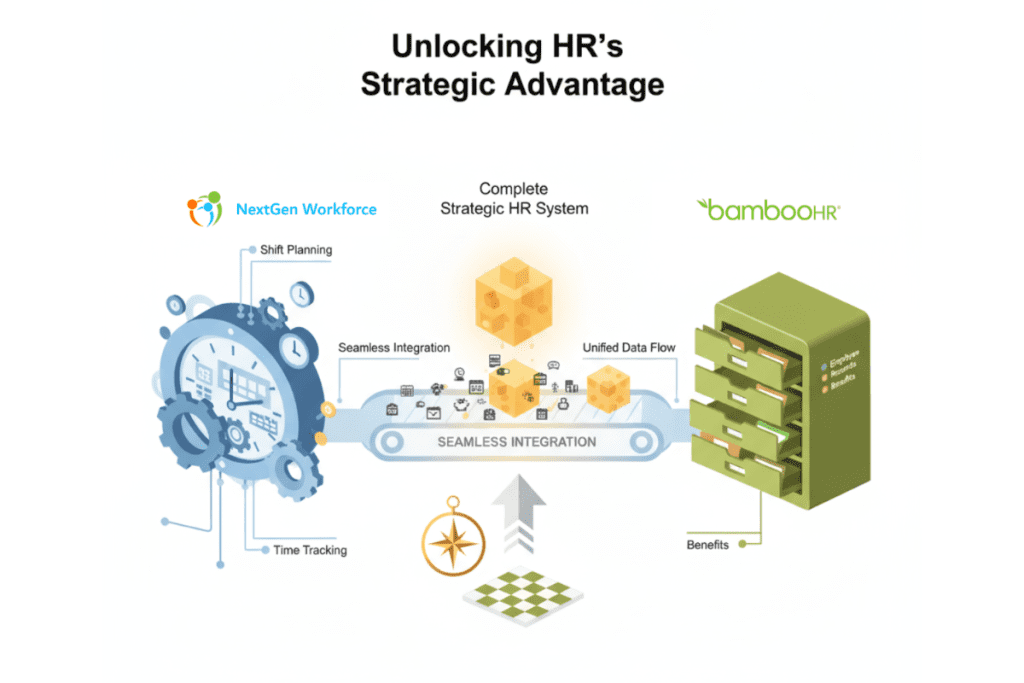
Efficiency for contemporary HR teams is not only about creating systems that link people, processes, and purpose; rather, it is fundamentally about enhancing overall effectiveness rather than just saving time. Because of this, furthermore, NextGen Workforce and BambooHR time tracking integration is more than just a practicality; indeed, it’s a strategic enabler that transforms how businesses organize, monitor, and manage their workforce. They enable businesses to function with clarity, confidence, and agility by combining real-time attendance tracking, advanced shift scheduling, and HR data synchronization into a single, seamless ecosystem. Why Integrated Time Tracking Matters Today’s HR directors oversee increasingly diverse workforces, which include workers dispersed throughout offices, remote locations, and field sites. Scheduling isn’t linear anymore. Attendance is, indeed, a data point connected to payroll, compliance, and productivity; furthermore, it’s more than just a punch on a clock. This is where the NextGen + BambooHR integration really shines: it gives a single, reliable source of truth for each employee’s time and activity by fusing scheduling intelligence with HR data. Don’t switch tabs. Spreadsheets cannot be exported. No updates by hand. A single, cohesive perspective on people, time, and shifts. 1. Smarter, Employee-Centric Scheduling Traditional scheduling can feel rigid—especially for hybrid teams and 24/7 operations. But with NextGen Workforce’s scheduling engine, BambooHR users get agile, people-first scheduling tools designed to adapt. Open Shifts: Using the platform, managers can post open shifts for qualified workers to directly claim. This promotes independence and quickly closes coverage gaps. Shift Swaps: Workers can simply ask for swaps with coworkers, maintaining an open and manager-approved procedure. Calendar Integration: Employees can plan their week with no guesswork thanks to schedules that easily sync with personal or business calendars. Unavailability Management: Employees can indicate when they are unable to work, which enables managers to make more intelligent scheduling decisions early on. NextGen and BambooHR immediately reflect every modification, bringing HR data, employee availability, and actual schedules into harmony. As a result, employees have more control over their work-life balance, and managers spend less time modifying shifts. 2. Real-Time Attendance Tracking That Syncs Automatically Payroll accuracy depends on accurate attendance data, which the integration makes sure occurs automatically. Unified Data Flow: BambooHR timesheets are updated in real time by all punches, breaks, and shift hours recorded in NextGen. Project & Job Tracking: To gauge effort, output, and resource use, allocate shifts or hours to particular projects or cost centers. Smart Notifications: To guarantee efficient operations, managers are promptly notified when punches are missed or overtime thresholds are reached. Mobile Access: Workers can view schedules, request shift changes, and clock in at any time, anywhere, using the NextGen mobile app. Without making daily tasks more difficult, this automation improves compliance and gets rid of manual entry errors. 3. Time-Off and Leave Management in Harmony The smooth operation of shift scheduling and time-off requests is one of the integration’s greatest benefits. NextGen automatically updates the scheduling interface when an employee submits a time-off request through BambooHR, allowing managers to view availability in real time. Approved time off immediately blocks scheduling conflicts. The Open Shift feature allows others to open replacement shifts. Every record is the same on both platforms. Because of this truly unified leave and scheduling experience, operations continue to run smoothly even during times of high vacation demand. 4. A Unified, Secure Experience for All Users With so many HR tools available, this integration guarantees security and user experience. SSO, or single sign-on: Stronger IT control, improved user adoption, and fewer passwords are all benefits of having a single secure login for both platforms. Consistent Design: Managers and staff can effortlessly transition between scheduling, attendance, and human resources duties thanks to familiar, user-friendly dashboards. Cloud-Based and Compliant: Both systems guarantee that your data is secure and prepared for audits by adhering to stringent labor compliance and data security standards. This unified experience simplifies workflows and the way people interact with their work systems. 5. Why HR Teams See It as a Strategic Advantage Not only does integrating NextGen Workforce with BambooHR streamline procedures, but it also completely changes the way HR functions. Business and HR executives benefit from this: Complete Visibility: insight into time off, attendance, and shifts in real time across teams and locations. Improved Forecasting: Data-driven choices to maximize productivity and plan labor. Increased Employee Engagement: Flexible scheduling and open visibility develop trust among employees. Improved Compliance: Automated recordkeeping guarantees accuracy and legal alignment. To put it briefly, this integration relieves HR of tedious administrative tasks so they can concentrate on strategy, engagement, and expansion. 6. Real-World Example: One View, Endless Efficiency Consider a retail chain that employs 150 people in three different locations. Managers use NextGen to schedule employees, publish open shifts for weekends, and switch coverage as needed. When someone takes PTO, they immediately make their shift available for others to claim, and they directly enter attendance into BambooHR timesheets. Payroll is produced using synchronized, validated data that is up-to-date. Avoid making two entries. Don’t double-check. Don’t wait. Efficient, accurate, and employee-empowering all combined into one is what seamless integration feels like. The Future of integrated Workforce Management Converting scheduling, attendance, and HR systems is not just functional; it transforms organizations in a world where flexibility defines success. HR professionals now have a single platform to work from thanks to the NextGen + BambooHR integration, which boosts compliance, simplifies management, and enhances the employee experience across the board. Making your work more human, efficient, and connected is the goal, not altering it. To learn how this integration can streamline your shift scheduling and attendance tracking, [Schedule a demo with NextGen Workforce.] This will allow your team to concentrate on what really matters: your people.
Integrating NextGen Time Tracking into the Hybrid & Remote Work Ecosystem

Did you know? According to a 2024 Gartner survey, half of organizations are currently running in some sort of hybrid or remote mode, although almost half of them acknowledge that they continue to have significant problems with regard to accurately tracking the time and productivity. That is, even as our places of work have changed, our systems have not changed significantly. NextGen Time Tracking comes in with the solution to making HR teams and contemporary brands adjust to the new reality of hybrid and remote employment with tools that provide flexibility, fairness, and real-time accuracy. Why Time Tracking Matters More Than Ever Visibility in a hybrid and remote environment is never about control but rather clarity. HR teams need to know: Who’s working, and when? Actual time of projects. Regarding whether the employees are receiving adequate rest or are feeling fatigued. In the meantime, the employees would like to feel that their time as well as their input is being appreciated well. A time tracker of the present day seals that trust gap. It offers transparent, secure, and accessible data that requires no micromanagement among managers and employees. The Challenge: Tracking Time Without Tracking People Remote work has rendered outdated the traditional time clocks. Manual tracking and spreadsheets cannot keep up with the work of employees operating in various time zones, in cafes, in job sites, or in home offices. This is the reason why NextGen Time Tracking is designed to take these contemporary challenges directly on. Common roadblocks that HR encounters in the present day: Lost punches because of low connection. Challenge in checking field or remote work. Tools time differences: tools versus payroll systems. Workers frustrated by terrible tracking software. It is not about tougher control but about smarter technology that will integrate well into the reality of the way the people work. How NextGen Simplifies Hybrid and Remote Time Tracking 1. Geolocation and Mobile Check-ins Instead of traditional punch clocks, employees can check in from their mobile devices. With geofencing, managers can set approved work zones, ensuring attendance is logged only from valid locations (like client sites or job areas). Example: A construction foreman clocks in from a project site; the system automatically validates their location; they do not need to enter it manually. 2. Smart Background Validation To prevent errors or misuse, NextGen quietly verifies activity in the background, confirming work sessions, breaks, or idle time without interrupting the employee’s flow. Reduces manual corrections. Improves accuracy without constant monitoring. Builds mutual trust through automation. 3. Seamless Integration with HR & Payroll Systems Tracking time is only half the job; getting that data where it needs to go is the real challenge. NextGen integrates with leading HRMS, project management, and payroll systems; therefore, you can: Sync approved hours directly to payroll. Link timesheets with project budgets and billing. Keep employee profiles updated automatically. This integration means fewer spreadsheets, fewer errors, and more confidence at payroll time. 4. Offline Logging for On-the-Go Teams What happens when field staff lose internet access? NextGen’s offline mode safely stores time logs and auto-syncs them once connectivity returns. It’s perfect for: Construction crews in remote sites. Service technicians on the move. Employees in regions with unstable networks. No one ever loses work hours. 5. Managing Without Micromanaging Time tracking should empower, not pressure. NextGen encourages autonomy and accountability through transparency: Employees can see their logged hours anytime. Managers receive insights, not surveillance. Alerts highlight anomalies (like early departures or overtime); consequently, they do so before they become problems. Key Takeaways for HR Teams and Brands. NextGen Time Tracking is built for modern work, hybrid, remote, and everything in between. Why it works: Adapts to mobile, remote, and field-based workflows. Protects employee privacy through secure, compliant logging. Syncs easily with HR, payroll, and project management systems. Works online and offline without disrupting teams. Provides actionable insights for smarter decisions. It’s not about watching your people; it’s about understanding your workforce. Final Thoughts: The Future Is Flexible. The future of work isn’t on the way; it’s here. And it’s hybrid, digital, and human. Embedding a next-gen time tracking solution provides your teams with the ability to work anywhere, while you maintain visibility, compliance, and peace of mind. If you’re an HR leader or brand looking to update your workforce operations, now’s the moment to move forward. [Book a Demo with NextGen Workforce] and see how effortless, transparent time tracking can transform the way your teams work.
Privacy, Compliance & Trust: Addressing Concerns in NextGen Time Tracking
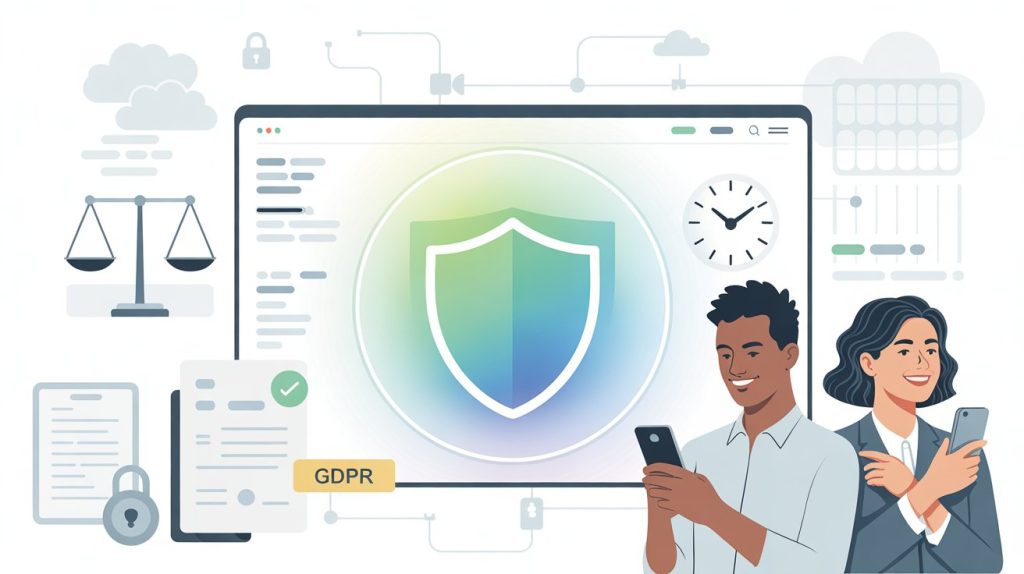
In this new era of cloud-based workforce systems, privacy and compliance are no longer an afterthought; they are the cornerstone of trust between employer and employee. NextGen time tracking solutions collect and process massive amounts of workforce data—from log-in times and locations to break duration to state and federally mandated records. Proper safeguards provide security against privacy breaches, compliance violations, and transparency. Let’s see how NextGen time-tracking platforms like NextGen Workforce address these issues—finding that balance of control with trust. Complying with Labor Laws and Data Protection Regulations New time-tracking tools are going to have to comply with applicable labor regulations (e.g., FLSA, the EU Working Time Directive, and applicable state wage and hour laws) and not violate the Global Data Protection Standards, such as GDPR and CCPA. NextGen Workforce provides: Legally defensible audit trails for every punch, edit, and approval. Automatically retained records to satisfy labor law retention requirements. User-based access controls restricting visibility of sensitive data. These features provide legal and compliance protection, enhance audit readiness, and minimize legal risk. [See how NextGen adheres to time tracking regulations.] Data Privacy: Encryption and Anonymization Data security works in tandem with privacy. NextGen tracking tools leverage encryption to secure personnel data during transit or when at rest. Sensitive identifiers (i.e., device IDs and IPs) can be anonymized before being exported or shared. Role-based permissions restrict exposure of personal records. Encryption built into multi-factor authentication improves access controls. By securing personal data through encryption, these systems safeguard employee identities while supporting the integrity of attendance records, which is critical for compliance reporting. Building Employee Trust: Eliminating the “Big Brother” Effect A frequent hindrance arising from new timekeeping systems relates to the feeling of continuous observation and scrutiny. Employees may feel as if someone is watching their every move. NextGen solutions address this with transparency and conversation: We clearly communicate what data we collect and the purpose behind that data. Allowing employees to view and verify their own time entries and logs. Demonstrating how tracking contributes to fairness and equity, ensuring they will receive every dollar in pay for every hour worked. Sufficiently framing timekeeping as a tool to protect and promote accurate pay rather than to surveil enhances organizational trust. Transparent Reporting and Employee Access Transparency is not only the right thing to do, but it is also smart. NextGen Workforce uses a secure dashboard, which allows all of your employees to see hours logged, adjusted hours, and debatable hours. This provides: Visibility on an hourly basis of time worked, the hours themselves, and the calculated payroll. Clarity around processes for requesting adjustments or clarifications. Understanding of how time translates to a paycheck. This type of transparency fosters the experience of fairness and eliminates confusion between HR, payroll, and employees. Audit-Ready Systems for Compliance Confidence When regulators or internal auditors come calling, therefore, NextGen time tracking prepares organizations in advance. The system digitally timestamps and stores each punch and edit in an immutable log. Users can generate reports instantly for labor audits or payroll verification. Integration with payroll and HR systems ensures consistency across records. This readiness not only saves time during inspections but also, furthermore, demonstrates proactive compliance management—critical for maintaining corporate credibility. Why It Works: Trust as the Core of Technology Adoption The greatest obstacle to integrating any digital time-tracking solution is not cost or complexity, but trust. NextGen Workforce assists HR leaders and compliance officers in overcoming privacy, compliance, and transparency concerns upfront, which allows for greater assurance that workforce data will be safe, fair, and sound. We can reassure employees that we will process their information legally and responsibly. The result? A workplace culture with accuracy, fairness, and trust—the true cornerstones of NextGen time tracking. [Book a Demo Today]
Beyond Punch Clocks: How NextGen Time Tracking Transforms Workforce Productivity
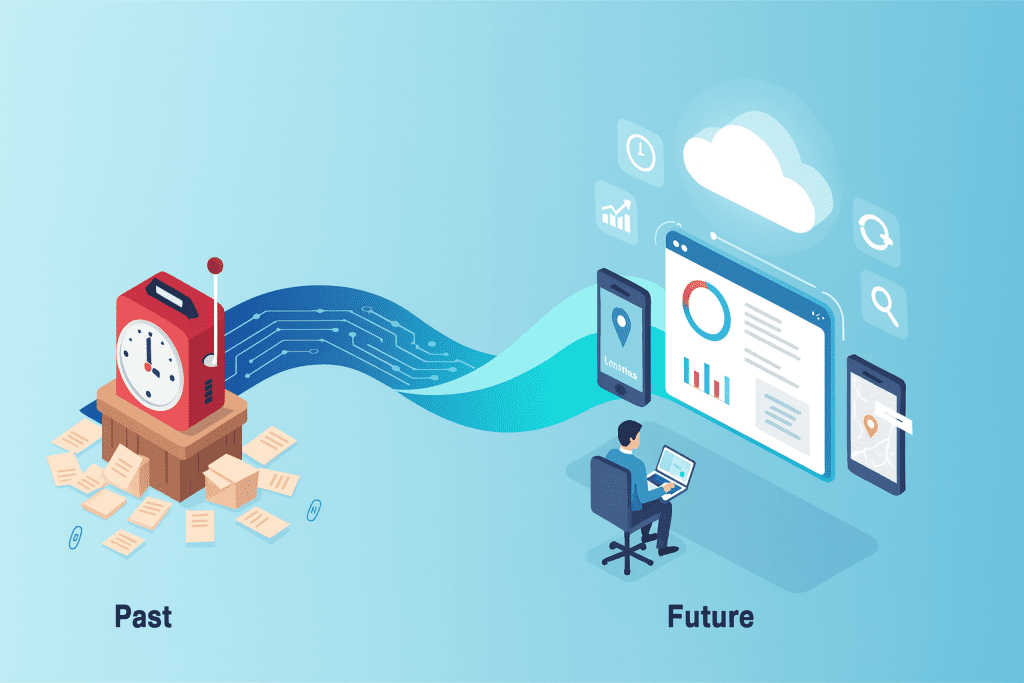
For many years, employee attendance was synonymous with the punch clock experience. Workers inserted metal timecards, manually oversaw entries, and performed reconciliations late into the evening. However, as workforces became distributed, hybrid, and tech-savvy, these older systems fell short. Today, time tracking and attendance monitoring have greatly expanded beyond a simple snapshot of attendance to become powerful engines of productivity and compliance. NextGen Workforce created their industry-leading cloud-based time tracking platform to provide visibility, mobility, and thoughtful insights. From Manual Tracking to Intelligent Workforce Management Traditional timekeeping relied heavily on manual entries and physical devices—leaving room for human error, time theft, and inefficiencies. Payroll teams spent hours correcting discrepancies, while managers lacked visibility into who was working, when, and where. The automation with the help of the clouds has transformed everything. Every clock-in, break, and clock-out with NextGen Time Tracking is automatically recorded and confirmed and synchronized in real time throughout the entire system – no spreadsheets, no guesswork. The result? Accurate attendance data at every site or department. Instant payroll-ready records. Reduced administrative workload for HR and operations. Real-Time, Mobile, and Geofenced Tracking In the current moveable working environment, the office door no longer represents the boundary of attendance checking. Teams operate in various locations, remote areas, and at client locations – the system provided by NextGen is designed to do all that. Mobile clock-in/out: The employees would use a single tap to mark their attendance using smartphones. Geofencing: The managers determine approved work areas such that only approved locations accept punches. Offline ability: Punches will be saved safely even in the absence of the internet and will automatically be synchronized once connected again. You can always tell who is at work, whether they are in the field or from home, and you can always know where. Smart Alerts That Prevent Timekeeping Errors Automated systems also cannot correct issues that managers do not observe; consequently, that is why NextGen provides an additional intelligence feature of sending real-time alerts. Missed punch? The system notifies both employee and supervisor instantly. Overtime threshold reached? HR gets a proactive warning before costs escalate. Attendance anomaly? The system alerts managers before it impacts productivity or compliance. By turning attendance data into actionable intelligence, organizations prevent small errors from becoming big payroll headaches. Turning Data into Decisions: Analytics & Dashboards The contemporary time tracking is indeed shining as it transforms data into valuable information. The reporting and analytics section by NextGen gives managers a clear picture of the behavior of the workforce: Trend of late arrival and early departure. Departmental trends of overtime. Site comparison on productivity and utilization. These insights help leaders make data-driven decisions—whether optimizing staffing levels, identifying burnout risks, or improving scheduling efficiency. It’s not just about tracking hours; it’s about understanding how you use time to drive better performance and profitability. Real-World Impact: Productivity in Action Leading organizations across industries are already seeing measurable results: Construction firms have, therefore, reduced payroll errors significantly; as a result, they have, in turn, replaced manual entries with biometric and mobile tracking. Retail chains have applied multi-site staffing to help them handle real-time data, and this approach minimizes overtime expenses to a great degree. Hospitality companies rely on geofenced tracking to ensure staff are clocking in at assigned locations, improving accountability and customer service. Each story proves one thing—modern time tracking isn’t about control; it’s about clarity and performance. The Future of Time Tracking Is Insight-Driven The workplace is changing rapidly; therefore, so should how you handle attendance. The time has passed for manually punching in; now it is time for an automated, intelligent solution that is built for change. NextGen Workforce makes time tracking more than just a record you have to keep; in fact, you turn it into a strategy. Smarter Insights. Stronger Compliance. Better Productivity. NextGen helps you punch above and beyond. Interested in learning more? How? [Book a Demo Today]
Modern Access Control System for Workforce Management
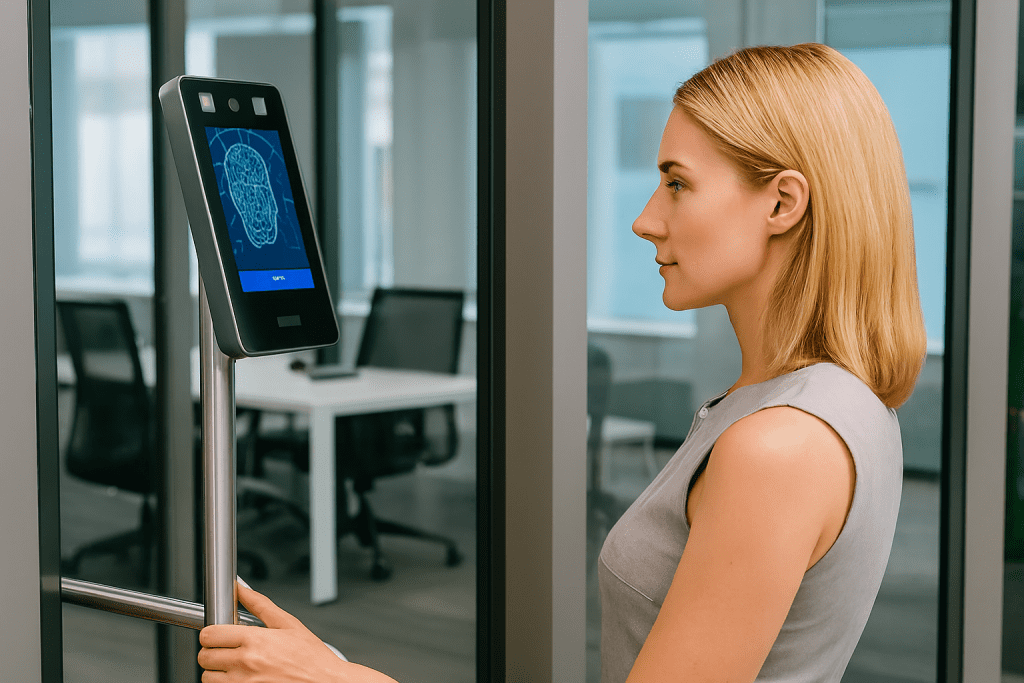
In today’s fast-paced workplaces, security and efficiency go hand in hand. Traditional keys and outdated punch clocks leave companies vulnerable to errors, unauthorized access, and compliance risks. That’s why modern organizations are adopting Access Control Systems—a solution that protects your facility, streamlines workforce management, and keeps compliance in check. What Is an Access Control System? An Access Control System manages who can enter or exit specific areas within your facility. Instead of relying on physical keys, employees use secure methods like: Fingerprint scans Face recognition Swipe cards or key fobs PIN codes or mobile apps When integrated with time tracking and payroll, access control isn’t just about doors—it becomes a complete workforce management tool. The Problems Access Control Solves Before diving into features, here’s what businesses often struggle with: Lost keys and security breaches. Manual attendance errors causing payroll disputes. Slow offboarding where ex-employees retain access. Compliance risks in emergencies (locked exits, missing logs). NextGen’s Access Control System is built to solve these exact problems. Smarter Security with Multiple Authentication Options Different workplaces have different needs. NextGen offers layered authentication methods so you can balance convenience and security: Tap-and-go proximity cards and key fobs. Biometric scans for high-security areas. PIN codes or mobile app access for flexible entry. This ensures only the right people, at the right time, enter your facility—minimizing risk and maximizing trust. HR & Payroll Integration: From Door to Paycheck One of the biggest frustrations for HR is reconciling attendance data with payroll. Manual syncing leads to errors, disputes, and compliance gaps. NextGen solves this by integrating access data directly with HR and payroll systems like BambooHR and QuickBooks: Attendance records sync automatically. PTO and leave requests flow seamlessly. Overtime is calculated without guesswork. Employee data stays centralized across platforms. This reduces paperwork, ensures accurate pay, and keeps you compliant with labor laws. Emergency Unlock & Safety First During an emergency, locked doors can put lives at risk. NextGen’s system comes with built-in emergency protocols: Manual exit buttons near every door. Immediate door unlocking during fire alarms or drills. Fail-safe mode to unlock doors in case of power outages. These features keep you OSHA and fire-safety compliant, while protecting your employees when it matters most. Time Tracking Without Extra Devices Why invest in separate punch clocks when access control can track attendance automatically? Every clock-in, clock-out, and break is: Logged in real time. Mapped to employee schedules. Synced with payroll for faster processing. Managers get visibility into punctuality, breaks, overtime, and PTO balances—all from one system. Instant Access Revocation for Leavers One of the biggest security risks? Employees who’ve left the company but still have access. NextGen automates this with Auto-Termination Sync: As soon as HR marks an employee inactive, all access permissions are revoked. No manual device-level updates required. Security remains airtight during offboarding. Easy to Install, Easy to Use You don’t need a big IT team or weeks of setup. NextGen’s Access Control is designed for plug-and-play simplicity: Wi-Fi or Ethernet connectivity. Cloud-based dashboard accessible anywhere. Step-by-step guides for fast setup. Whether securing one office or multiple sites, you’ll be up and running in hours, not days. How to Get Started Plan your access points – doors, gates, or sensitive areas. Choose authentication methods – cards, biometrics, or mobile. Connect devices via Wi-Fi/Ethernet. Set access levels by role or department. Integrate with HR/payroll for automation. Train staff on daily use and emergency exits. Final Thoughts Access control is no longer just about locking doors. It’s about: Protecting your people and assets. Reducing HR and payroll headaches. Ensuring compliance at every step. With NextGen’s Access Control System, you get a solution that’s secure, simple, and scalable—designed for modern organizations that want peace of mind and productivity in one package. Ready to secure your workplace and simplify workforce management? [Book a Demo Today]
Open Shift Scheduling: A Smarter Approach to Flexible Workforce Scheduling
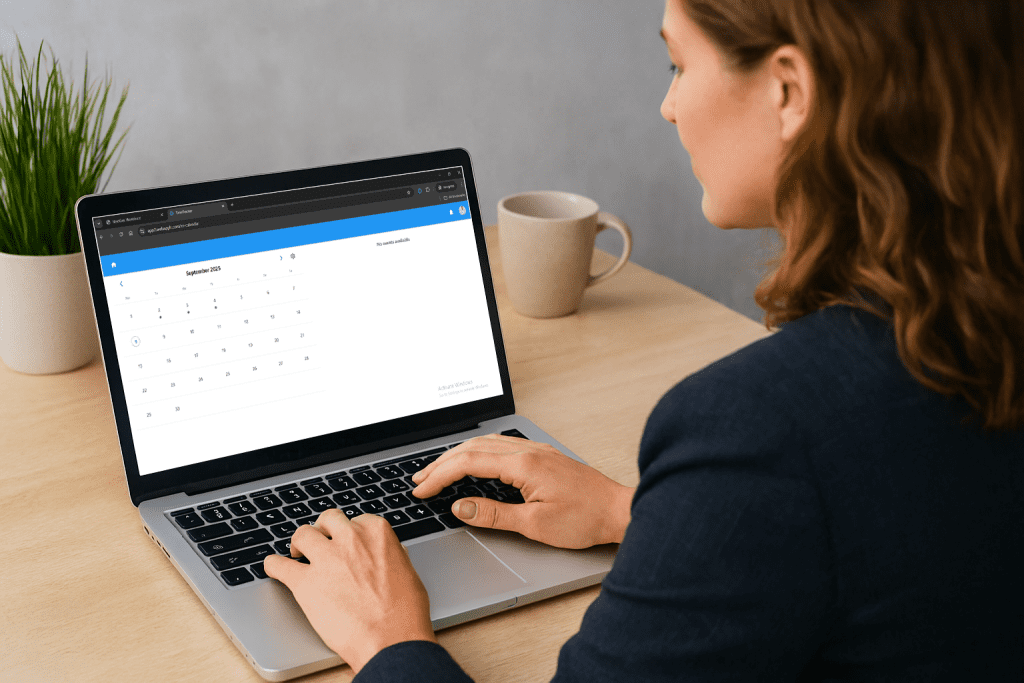
Managing employee schedules has always been a balancing act for HR and operations leaders. From unexpected call-offs and strict overtime regulations to compliance requirements like California OT, even the most organized managers can find themselves rushing to plug gaps at the last minute. This is where NextGen Workforce steps in. With our Open Shift module, managers and employees can seamlessly manage unassigned or released shifts—eliminating the endless chain of emails and messy spreadsheets. Paired with Unavailability tracking, businesses gain a clear, real-time view of staff availability, making scheduling smarter, faster, and fully compliant. Open Shifts Explained: A Fair Way to Fill Gaps Open shift scheduling transforms the way businesses handle workforce coverage. Instead of managers scrambling to call, text, or email staff at the last minute, managers can simply publish available shifts—daily, weekly, or monthly—and let eligible employees claim them directly. The process is transparent, structured, and employee-driven, creating fairness on both sides. With NextGen Workforce, managers have the flexibility to: Release predefined shifts by day, week, or month Assign open slots by role, department, or group Limit eligibility based on skills, tags, or specific employees Control how many seats are available (e.g., 2 morning slots, 5 standard 10–5 slots) This level of control not only ensures compliance and coverage but also reduces scheduling stress, while giving employees greater autonomy over when and how they work. Employees Releasing Shifts Made Simple Sometimes life gets in the way, and employees can’t make a scheduled shift. With one click, they can release it back into the Open Shift pool for others to claim. Assigned shifts appear directly in each employee’s calendar. Releasing sends the shift back to the open pool instantly. Managers can limit who can pick it up (specific teams, departments, or individuals). Everything stays visible and trackable—no side deals or missed updates. Approval Workflows: Compliance Meets Flexibility When an employee wants to pick up an open shift, requests move through a configurable approval flow. Define single or multi-level approvals (manager, supervisor, HR). Prevent accidental violations of labor rules (breaks, OT caps, consecutive hours). Keep visibility across the scheduling dashboard. This ensures flexibility doesn’t come at the cost of compliance. Unavailability: The Other Half of Flexibility If open shifts give employees more opportunities to pick up work, unavailability tracking provides the guardrails managers need to schedule smarter. Instead of guessing or constantly checking with staff, managers can see in real time when employees are not available—preventing conflicts, wasted outreach, and unnecessary frustration. Key benefits include: Managers avoid offering shifts to unavailable staff Employees can safeguard personal commitments without repeated explanations Recurring patterns (like every Tuesday evening) can be set once and remembered Open shifts are automatically hidden from employees who have marked themselves unavailable Together, open shifts and unavailability create a complete picture of workforce availability. Managers always know who can step in, who cannot, and how to fill coverage gaps fairly and efficiently. Smarter Scheduling With Advanced Rules NextGen Workforce takes scheduling beyond simple shift swapping by adding intelligent guardrails that protect both the business and its employees. With advanced rules, managers can ensure every shift is filled fairly, efficiently, and in full compliance with labor regulations. Examples include: Allowing only employees under 40 hours that week to pick up shifts Restricting eligibility to staff with required skills or certifications (e.g., nurse assistants, forklift operators) Automatically enforcing labor laws—such as mandated meal breaks or consecutive rest periods These safeguards remove guesswork from scheduling, helping managers avoid burnout, reduce overtime costs, and eliminate the risk of costly compliance violations. The result is a smarter, more sustainable workforce strategy that benefits everyone. Industry Impact: Where Open Shifts Shine Dynamic industries with ever-changing staffing needs see the biggest impact from flexible scheduling. Some key examples include: Healthcare: Nurses and medical staff can quickly pick up available shifts without waiting for manual approvals—ensuring consistent patient care. Construction: Teams can be reallocated as project timelines shift, keeping work on track without staffing gaps. Logistics & Warehousing: Seasonal surges and fluctuating demand are handled smoothly, without overworking existing staff. Retail & Call Centers: Extra coverage during peak hours or across global time zones becomes easy to manage, reducing stress for both managers and employees. Final Thoughts Managing open shifts doesn’t have to feel chaotic. With NextGen Workforce’s Open Shift and Unavailability modules, managers can release, approve, and fill shifts with confidence, while employees maintain control over when they can and cannot work. The outcome is simple: better coverage, happier employees, and full compliance with labor laws. Ready to see how flexible scheduling can transform your business? [Book a Demo Today]