Payroll-Ready Workforce Management Software for Complex Hourly Teams
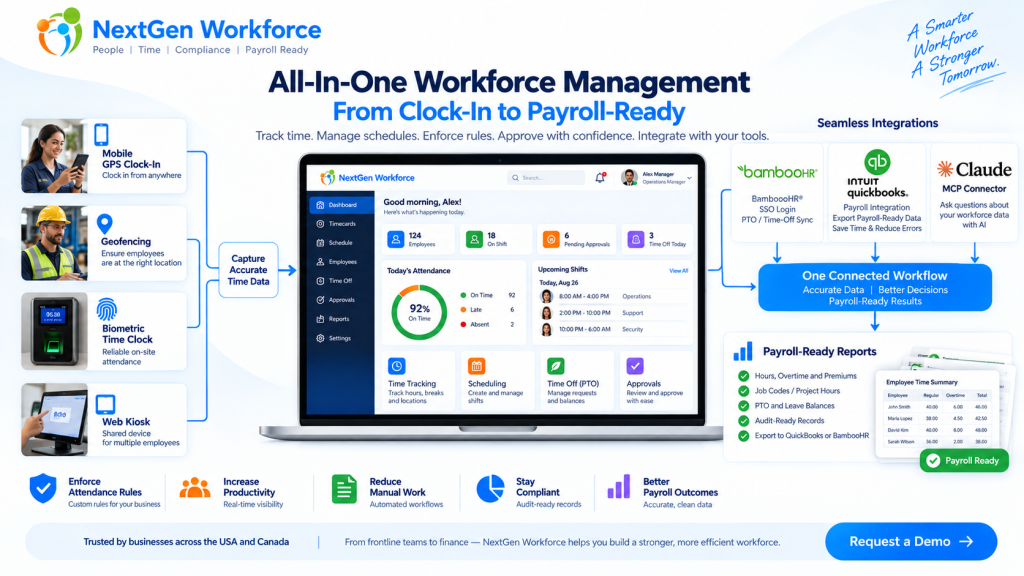
Payroll-Ready Workforce Management Software for Complex Hourly Teams You do not need another time clock. You need clean workforce data before payroll runs. That is the real problem for many growing businesses. Employees clock in. Managers adjust schedules. PTO gets approved. Overtime happens. Job codes change. Someone forgets a punch. A field employee clocks in from the wrong location. Then payroll day arrives, and the team has to clean everything manually. Sound familiar? Payroll-ready workforce management software helps businesses collect employee time, apply attendance rules, manage schedules, review exceptions, approve records, and prepare cleaner data before payroll processing. NextGen Workforce brings time tracking, attendance, scheduling, biometric clocks, mobile GPS, geofencing, PTO, approvals, custom rules, and payroll-ready reports into one connected workflow. Still Cleaning Time Data Before Every Payroll? NextGen Workforce helps your team capture accurate time, review exceptions, approve hours, and prepare payroll-ready reports before payroll runs. Talk To An Expert What Is Payroll-Ready Workforce Management? Quick answer: Payroll-ready workforce management connects the work that happens before payroll: time tracking, attendance, scheduling, PTO, overtime, approvals, job codes, and reporting. A basic time clock records hours. That is useful, but it is only the beginning. Payroll needs more than a clock-in and clock-out time. It needs clean, reviewed, categorized, and approved workforce data. That means payroll teams need to know: Did the employee work the scheduled shift? Are there missing punches? Was overtime approved? Was PTO already approved in the HR system? Did the employee work at the correct location? Which job, project, department, or client should the hours go to? Did the manager approve the timecard? Are the hours ready to send to payroll? Payroll-ready workforce management is the system that helps answer those questions before payroll day. For a business with simple office hours, this may not feel urgent. But for hourly teams, field employees, multi-location operations, manufacturing teams, hospitality groups, healthcare teams, construction crews, and businesses with custom rules, this can become a weekly problem. Why Payroll Problems Usually Start Before Payroll Quick answer: Payroll errors often start earlier in the workflow, when punches, schedules, PTO, overtime, approvals, and job data are incomplete or disconnected. Payroll software can process payroll. But it cannot magically fix messy attendance data. If an employee forgot to clock out, payroll still needs someone to fix the record. If overtime was not approved, someone has to ask the manager. If PTO is approved in one system but not visible on the timesheet, payroll has to compare records manually. Here is a simple example. A field employee visits a client site. They clock in from mobile, work for six hours, and leave. Payroll later needs to know the employee’s hours, location, client, project, order number, and approval status. If that information was not captured during the workday, someone has to reconstruct it later. That is where time gets wasted. Payroll cleanup is rarely just a payroll problem. It is usually a workforce data problem. Why Time Tracking Alone Is Not Enough Quick answer: Time tracking tells you when employees worked. Payroll-ready workforce management also tells you whether the work was scheduled, approved, categorized, compliant with company rules, and ready for payroll. A time clock answers one question: When did the employee work? A payroll-ready workforce system answers a better question: Is this record complete, correct, approved, and ready for payroll? That is a big difference. For example, a timecard may show 46 hours for the week. But before payroll processes those hours, the business may still need to review: regular hours overtime hours double-time rules where applicable holiday rules meal or break rules job codes department allocation project or client hours manager approval audit history Without that review layer, payroll teams end up doing manual checking. And manual checking does not scale well. The Core Pieces of a Payroll-Ready Workforce System Quick answer: A payroll-ready workforce system should connect time capture, scheduling, attendance rules, PTO, approvals, reporting, and payroll integrations. Each part matters on its own. But the real value comes when they work together. 1. Time Tracking Employees need a reliable way to clock in and out. NextGen Workforce supports multiple time capture workflows, including web clock, kiosk, mobile app, and biometric time clock options. This gives businesses flexibility. Office employees may use a web clock. Field employees may use mobile GPS. On-site teams may use biometric devices. Shared workstations may use kiosk workflows. 2. Attendance Management Attendance is more than recording time. Managers need visibility into late arrivals, early departures, missed punches, long shifts, exceptions, and incomplete records. NextGen Workforce helps teams review attendance issues before they become payroll problems. 3. Employee Scheduling Schedules help payroll and operations compare planned work with actual hours. When scheduling and time tracking are disconnected, managers may not notice coverage gaps, unexpected overtime, or schedule mismatches until later. NextGen Workforce connects schedules with attendance records so teams can review what was planned versus what actually happened. 4. PTO and Time-Off Visibility PTO affects payroll, scheduling, coverage, and attendance review. If PTO is approved but not visible in the timecard workflow, payroll has to check another system. NextGen Workforce supports PTO and time-off workflows, including integrations such as BambooHR time-off sync where configured. 5. Custom Attendance Rules Every business says, “Our rules are simple.” Then payroll day comes. One department has a different overtime rule. One location has holiday rules. One customer needs custom job codes. One policy requires manager approval before overtime becomes payable. Another team needs meal premium tracking or break deductions. This is where many basic time tracking tools struggle. NextGen Workforce is designed for configurable attendance rules, including overtime, breaks, rounding, holidays, premiums, exceptions, approval rules, and customer-specific workflows. 6. Approvals Payroll should not have to guess whether time is approved. A strong workflow should show whether the employee submitted the record, the manager approved it, and payroll can process it. NextGen Workforce supports manager review and approval workflows so payroll can work from clearer records. 7. Payroll-Ready Reports and Exports Payroll-ready
Overtime Request Automation: Paid Overtime or Time Off in Lieu Before Payroll
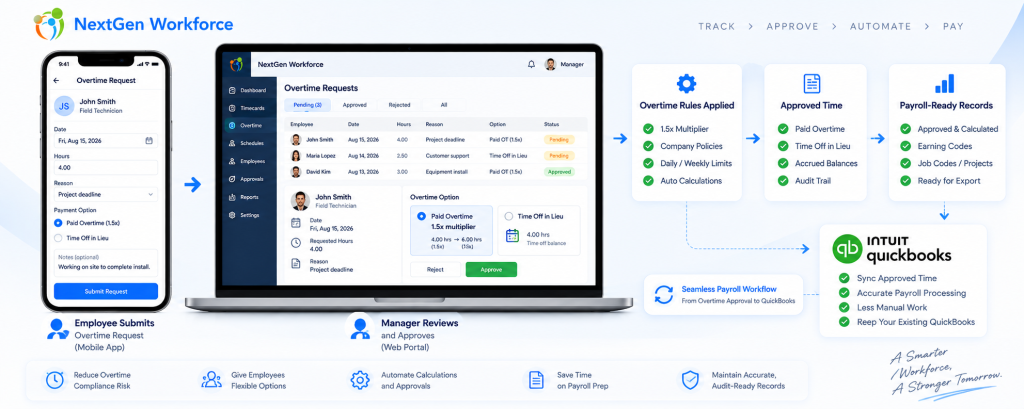
Overtime Request Automation: Paid Overtime or Time Off in Lieu Before Payroll By NextGen Workforce Editorial Team Last updated: September 2026 Overtime approval should happen before payroll, not during payroll cleanup. NextGen Workforce helps businesses manage overtime requests, approvals, paid overtime, time off in lieu, configurable multipliers, audit history, and payroll-ready records before payroll runs. For many businesses, overtime becomes a payroll problem because the approval happens too late. An employee works extra hours. A manager reviews it after the pay period. Payroll has to confirm whether the hours were approved, whether they should be paid, whether they should be converted to time off in lieu, and whether the correct earning code or balance should be updated. That creates manual cleanup. NextGen Workforce helps move this process earlier by giving employees and managers a structured overtime request workflow. Still Approving Overtime by Email or Spreadsheet? NextGen Workforce helps employees request overtime, choose paid overtime or time off in lieu, route approvals, apply configurable multipliers, and prepare payroll-ready records. Talk To An Expert Why Overtime Requests Need a Better Workflow Quick answer: An overtime request workflow helps employees submit extra hours for review, lets managers approve or reject those hours, and gives payroll clear instructions before processing paid overtime or time off in lieu. Overtime is not only a payroll calculation. It is also an approval process. Payroll teams need to know whether the extra time was authorized, why it happened, who approved it, and how it should be handled. Without a structured workflow, overtime decisions often happen through emails, messages, spreadsheets, or verbal approvals. That creates several problems: Employees work extra time without approval. Managers approve overtime too late. Payroll does not know whether overtime should be paid or banked. Time off in lieu balances are updated manually. Rejected overtime has no clear audit history. Payroll-ready reports need last-minute correction. A good overtime request workflow gives everyone the same record. The employee submits the request. The manager reviews it. Payroll receives approved and categorized data. Paid Overtime vs. Time Off in Lieu Quick answer: Paid overtime means approved extra hours are paid through payroll. Time off in lieu means approved overtime is converted into paid time off or banked time, where allowed by law and company policy. Businesses may handle approved overtime in different ways depending on country, province, state, employment agreement, employee classification, and company policy. In many Canadian employment contexts, time off in lieu or banked overtime can be allowed when specific rules are followed. For example, Canadian federal labour standards describe overtime compensation as either overtime pay or time off with pay equivalent to 1.5 hours for every overtime hour worked, subject to applicable rules. However, this is not universal everywhere. In the United States, covered nonexempt private-sector employees are generally entitled to overtime pay under the Fair Labor Standards Act. Employers should verify whether compensatory time off is allowed for their specific workforce before offering it. Option What It Means Payroll or Balance Impact Paid overtime Approved extra hours are paid at the applicable overtime rate Payroll earning code is updated Time off in lieu Approved overtime is converted into paid time off or banked time where allowed Time bank or leave balance is credited Pending approval Request is waiting for manager review Not finalized for payroll Rejected request Manager denies the overtime request Handled based on company policy and legal requirements The key is clarity. Payroll should not have to guess whether approved overtime should be paid or credited as time off in lieu. How the 1.5x Time Off in Lieu Rule Can Work Quick answer: Where time off in lieu is allowed, a company may credit overtime hours at a configured multiplier, such as 1.5x. For example, 2 approved overtime hours can become 3 hours of banked time. Some businesses allow employees to receive paid time off instead of paid overtime. This is often called: time off in lieu TOIL banked overtime compensatory time time bank Example: Approved Overtime Hours Multiplier Time Off in Lieu Credit 1 hour 1.5x 1.5 hours 2 hours 1.5x 3 hours 4 hours 1.5x 6 hours With NextGen Workforce, this can be handled as a configurable policy. For example, if an employee requests 2 hours of approved overtime as time off in lieu, the system can credit 3 hours to the employee’s time bank when the configured multiplier is 1.5x. This helps reduce manual balance updates and gives payroll a clearer audit trail. Why Retroactive Overtime Requests Matter Quick answer: Retroactive overtime requests allow employees to submit overtime after the work was performed, within a configured window such as 72 hours. This helps businesses handle emergency work without losing approval control. Not all overtime is planned in advance. Sometimes employees work extra hours because of an emergency, customer request, production issue, staffing gap, late shift coverage, or urgent project deadline. In those cases, a strict “advance approval only” process may not reflect reality. That is why many businesses need a retroactive overtime request window. For example, a company may allow employees to submit overtime requests for previous days within a configured window, such as 72 hours after the work was performed. This is not presented as a universal legal rule. It is a company policy setting. The benefit is control. Employees can explain why overtime happened. Managers can approve or reject the request. Payroll can see the approval decision before processing. The system can keep an audit record. This helps prevent overtime from becoming an unstructured payroll exception. How NextGen Workforce Automates Overtime Requests Quick answer: NextGen Workforce can automate overtime requests by allowing employees to select the date, hours, reason, and preferred handling method, then route the request to a manager for approval before payroll. A practical overtime request workflow can look like this: Employee selects the overtime date. Employee enters requested overtime hours. Employee chooses paid overtime or time off in lieu, where allowed. Employee adds a reason or note. System checks the request window, such
Why Payroll Errors Happen (And How to Prevent Them Before Payroll Runs)
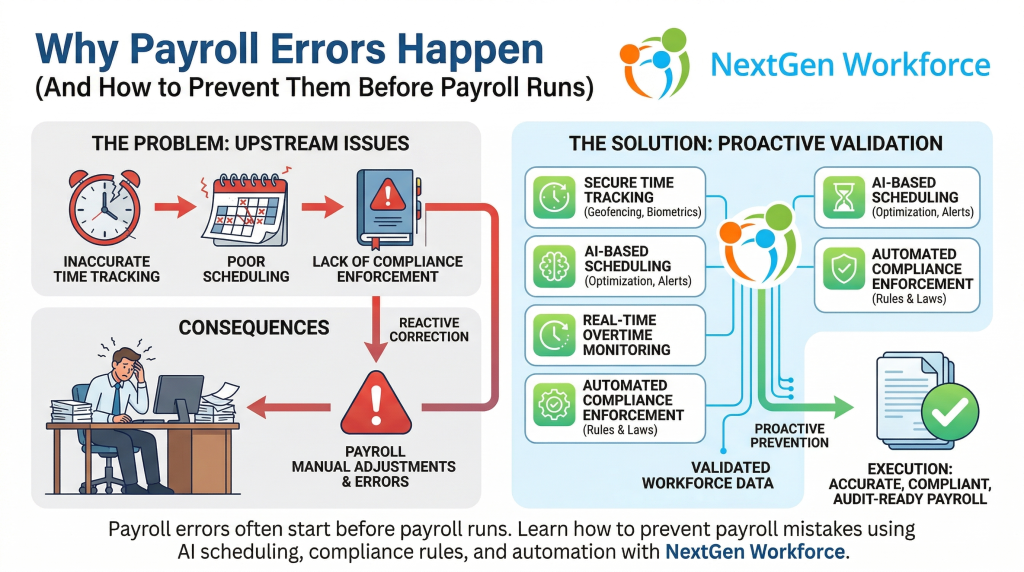
Summary Payroll errors are rarely caused by payroll software. Most payroll mistakes originate from inaccurate time tracking, poor scheduling, and lack of compliance enforcement. Businesses can prevent payroll errors by using systems that validate workforce data before payroll processing. NextGen Workforce combines time tracking, scheduling, compliance rules, and automation to ensure accurate and audit-ready payroll. Introduction Payroll is one of the most critical functions in any organization. But despite using modern payroll systems, many businesses still face: incorrect employee hours overtime miscalculations missed compliance rules manual adjustments during payroll processing The assumption is often that payroll software is the problem. In reality, payroll errors usually happen before payroll even begins. What Causes Payroll Errors? Payroll errors are typically the result of upstream issues. 1. Inaccurate Time Tracking If employee work hours are not captured accurately, payroll calculations will be wrong. Common issues include: missed clock-ins or clock-outs manual time edits buddy punching or proxy attendance lack of real-time validation When inaccurate data enters payroll, errors become unavoidable. 2. Poor Scheduling Practices Scheduling directly impacts payroll. Without proper scheduling controls: employees may exceed daily or weekly limits overtime may go unnoticed until payroll shifts may be assigned without considering compliance rules Scheduling mistakes lead to payroll corrections later. 3. Overtime Mismanagement Overtime is one of the biggest contributors to payroll errors. Businesses often struggle with: tracking weekly vs daily overtime identifying when employees cross thresholds managing unexpected overtime Without proactive monitoring, overtime issues surface during payroll processing. 4. Lack of Compliance Enforcement Labor laws vary by region and can include: overtime regulations meal and rest break requirements shift length rules If these rules are not enforced during scheduling and attendance tracking, payroll teams are left to fix issues manually. 5. Manual Adjustments During Payroll When systems do not validate data in advance, payroll teams must: review timesheets manually correct errors adjust hours verify compliance This increases processing time and creates room for human error. What Is the Real Problem? The real issue is not payroll software. It is the lack of data validation before payroll processing. Most businesses treat payroll as the point of correction. Instead, payroll should be the point of execution. How to Prevent Payroll Errors Before Payroll Runs To eliminate payroll errors, businesses must shift from reactive correction to proactive validation. 1. Use Accurate Time Tracking Systems Implement systems that ensure: real-time clock-in validation biometric or secure attendance tracking location-based verification (geofencing) automatic logging of work hours Accurate input leads to accurate payroll. 2. Optimize Scheduling Before Shifts Begin Scheduling should consider: employee availability labor rules overtime thresholds workload distribution Preventing issues at the scheduling stage reduces payroll corrections later. 3. Monitor Overtime in Real Time Instead of detecting overtime during payroll: track employee hours continuously receive alerts before thresholds are crossed adjust schedules proactively This helps control labor costs and avoid last-minute adjustments. 4. Enforce Compliance Automatically Use systems that apply labor rules automatically, such as: overtime calculations break requirements shift restrictions Automation reduces dependency on manual checks. 5. Integrate Scheduling, Attendance, and Payroll Disconnected systems create gaps. An integrated approach ensures: scheduling aligns with attendance attendance data flows into payroll accurately compliance rules are consistently applied This creates a single source of truth. What Is AI Employee Scheduling’s Role in Payroll Accuracy? AI employee scheduling helps prevent payroll issues before they occur. It does this by: analyzing workforce data identifying overtime risks optimizing shift assignments ensuring compliance during scheduling Instead of reacting to errors, businesses can avoid them entirely. How NextGen Workforce Helps Prevent Payroll Errors NextGen Workforce is designed to eliminate payroll errors at the source. The platform combines: AI-based employee scheduling biometric time tracking geofencing and real-time attendance validation automated compliance rules intelligent timesheet review payroll-ready data processing This ensures that by the time payroll runs: the data is already accurate, compliant, and validated. The Human Impact of Payroll Errors Behind every payroll error is a person. A payroll manager working late to fix discrepancies.An HR leader dealing with employee complaints.A business owner worrying about compliance penalties. Preventing payroll errors is not just about efficiency. It is about reducing stress, improving trust, and ensuring confidence in every payroll cycle. Final Thoughts Payroll errors are not a payroll problem. They are a workforce management problem. Businesses that focus on accurate time tracking, optimized scheduling, compliance automation, and integrated systems can eliminate most payroll issues before payroll runs. This is where modern workforce platforms like NextGen Workforce create real value. Frequently Asked Questions Why do payroll errors happen? Payroll errors usually happen due to inaccurate time tracking, poor scheduling, overtime mismanagement, and lack of compliance enforcement before payroll processing. Can scheduling impact payroll accuracy? Yes. Scheduling decisions directly affect employee hours, overtime, and compliance, which all influence payroll outcomes. How can businesses reduce payroll errors? Businesses can reduce payroll errors by using integrated systems that validate time tracking, scheduling, and compliance before payroll runs. What role does AI play in payroll accuracy? AI helps analyze workforce data, optimize scheduling, detect overtime risks, and ensure compliance, reducing errors before payroll processing.