
Certified Payroll Reports: Track Time and Compliance Before Payroll
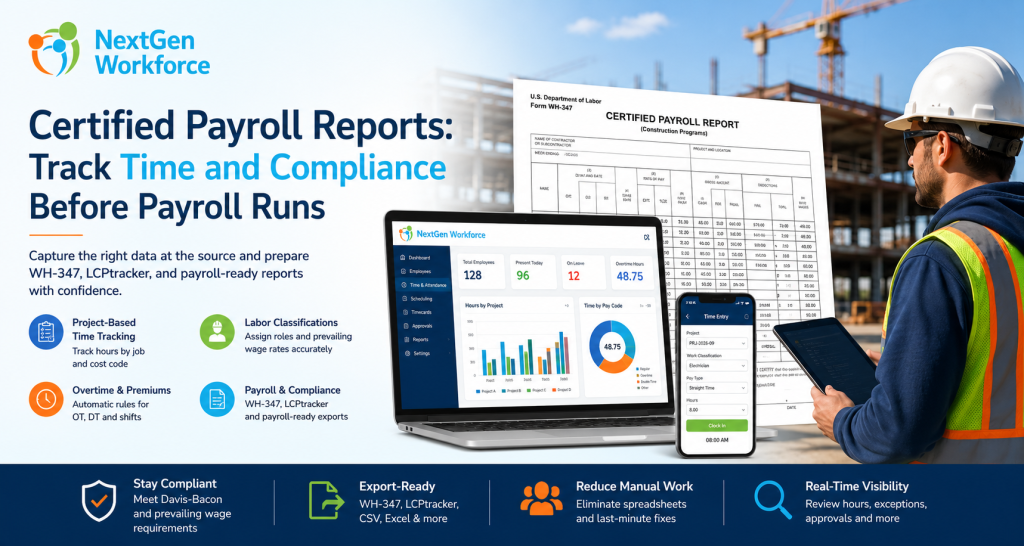
Certified Payroll Reports: What Contractors Need To Track Before Payroll Runs By NextGen Workforce Editorial Team Last updated: June 2026 Certified payroll reporting is not just a payroll task. Certified payroll reports depend on accurate time, project, worker classification, wage, overtime, and fringe benefit data captured during the week. If those details are missing from the timecard, payroll teams are forced to rebuild the report manually later. That is where many contractors struggle. An employee works on a public project in the morning and a private job in the afternoon. Another worker changes classification for part of the week. A foreman approves overtime, but the project code is missing. Payroll needs prevailing wage details, fringe benefits, deductions, and a weekly compliance report. When this information is spread across paper timesheets, spreadsheets, payroll notes, and manager emails, certified payroll becomes painful. NextGen Workforce helps contractors capture the right workforce data before payroll runs. Time, project codes, job classifications, overtime, approvals, and payroll-ready records can be managed in one connected workflow. Still Preparing Certified Payroll Manually? NextGen Workforce helps contractors track project time, job classifications, overtime, approvals, and payroll-ready records before certified payroll reports are prepared. Give payroll cleaner data before WH-347, LCPtracker-style exports, or public works compliance reports are due. Talk To An Expert What Is A Certified Payroll Report? Quick answer: A certified payroll report is a weekly compliance report used on many public works and federally funded construction projects. It documents employee hours, work classifications, wage rates, deductions, and a signed compliance certification. Certified payroll reporting is commonly connected to public works and prevailing wage projects. For federal Davis-Bacon and Related Acts projects, contractors and subcontractors may use Form WH-347 to submit weekly certified payroll information. The report helps show that workers were paid the required prevailing wage rates and fringe benefits for the covered work performed. The “certified” part matters. Each certified payroll must be accompanied by a signed Statement of Compliance. That statement confirms the payroll information is accurate and complete, and that workers were paid at least the required prevailing wage and fringe benefits for the work performed. In practice, this means certified payroll is not only about totals. It is about proving that the right person worked the right hours, on the right project, under the right classification, at the right wage rate. Why Certified Payroll Reporting Is Hard To Manage Manually Quick answer: Certified payroll is hard to manage manually because contractors must connect timecards, project codes, worker classifications, prevailing wages, overtime, fringe benefits, deductions, and compliance forms without errors. Manual certified payroll usually breaks down before payroll even starts. The problem starts with data capture. If employees do not select the correct project or job code, payroll may not know which hours belong to the public works project. If workers change roles during the week, payroll must know which classification applied to each block of time. Then the payroll team has to handle overtime, fringe benefits, deductions, and report formatting. That creates several risks: Wrong project hours: Public and private job hours may get mixed. Wrong classification: A worker may be paid under the wrong prevailing wage rate. Missing daily detail: WH-347-style reporting needs day-by-day hours. Overtime errors: Straight time and overtime must be separated correctly. Fringe benefit confusion: Cash fringe and benefit-plan contributions may need separate tracking. Late approvals: Payroll may wait for supervisors to confirm missing details. Export cleanup: Data may need spreadsheet work before WH-347 or portal upload. As a result, certified payroll becomes a weekly scramble. Contractors do not only need payroll software. They need accurate workforce data before payroll begins. Key takeaway: Certified payroll reports are only as reliable as the time, project, classification, and wage data behind them. What Data A Time Tracking System Must Capture Quick answer: A time tracking system should capture project, employee, classification, daily hours, straight time, overtime, wage rate, fringe benefit, gross pay, deductions, and net pay data to support certified payroll reporting. For certified payroll, a basic clock-in and clock-out record is not enough. The timecard should capture the details payroll needs later. Data Needed Why It Matters Manual Risk Project or job code Separates public works hours from other work Hours may be reported under the wrong project Labor classification Determines the correct prevailing wage rate Worker may be paid under the wrong role Daily hours Supports day-by-day certified payroll reporting Payroll may lack daily detail Straight time and overtime Separates regular and overtime hours Pay categories may need manual correction Prevailing wage rate Supports wage compliance by classification Wrong rate may be applied Fringe benefits Tracks benefit value or cash fringe handling Fringe totals may be missed or miscalculated Approvals Confirms manager review before payroll Payroll may chase supervisors later Export-ready records Supports WH-347, payroll, or compliance portal workflows Spreadsheet cleanup becomes unavoidable When this data is captured correctly during the week, certified payroll becomes easier to prepare. When it is not captured correctly, payroll has to reconstruct the story after the fact. How NextGen Workforce Helps Contractors Prepare Certified Payroll Data Quick answer: NextGen Workforce helps contractors capture project-based time, labor classifications, job codes, overtime, approvals, and payroll-ready records before certified payroll reports are prepared. NextGen Workforce is built for businesses that need more than basic time collection. For contractors, the system can help turn daily time tracking into structured payroll-ready data. Step 1: Capture Time By Project Or Job Code Employees should not only clock in. They should be able to track time against the correct project, job, client, or cost code. This helps separate public works hours from private project hours before payroll begins. Step 2: Track Labor Classification On The Time Entry Certified payroll depends on classification. A worker may perform different types of work during the same week. For example, a crew member may work under one classification on Monday and another classification on Wednesday. NextGen Workforce can support time tracking workflows where job, task, work code, or classification details are tied to