Canada Overtime Rules: Why Time Tracking Software Needs Flexible Attendance Rules
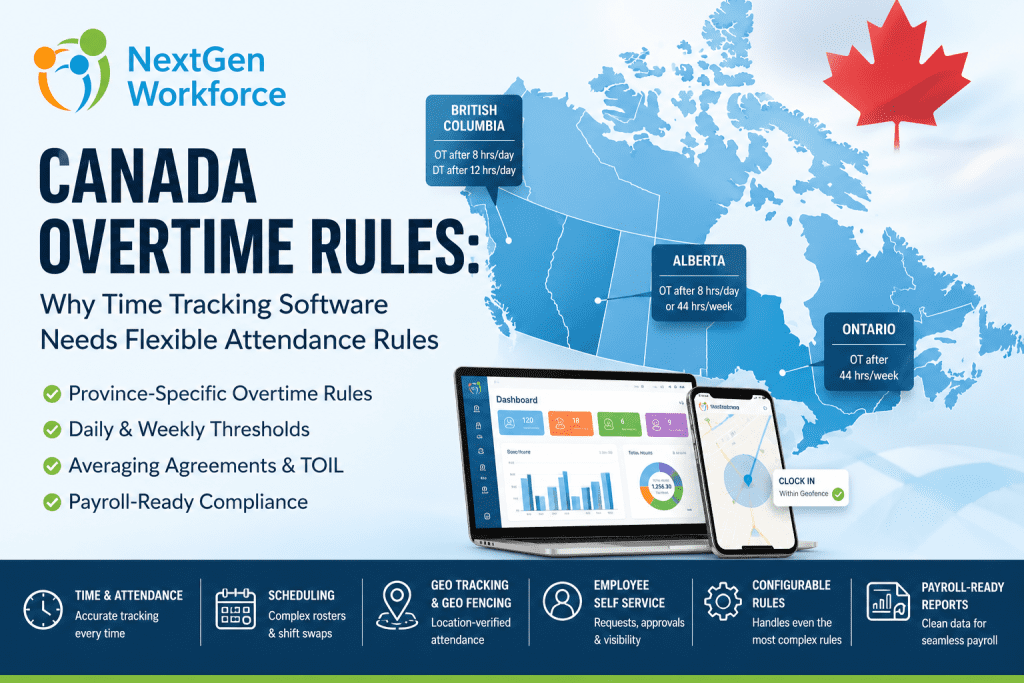
Canada Overtime Rules: Why Time Tracking Software Needs Flexible Attendance Rules By NextGen Workforce Editorial Team Last updated: June 2026 Canada overtime rules are not one-size-fits-all. Canada overtime rules depend on jurisdiction, province, industry, employee classification, union agreements, averaging agreements, and employment contracts. A rule that works for Ontario may not work for Alberta, British Columbia, or a federally regulated workplace. That creates a real problem for HR and payroll teams. In practice, they are not only tracking hours. They are also tracking the rule behind those hours. One employee may trigger weekly overtime. Another may trigger daily overtime. A third may work under an averaging agreement. Meanwhile, another employee may bank overtime as time off in lieu. For field teams, the workflow can get even more complex. A mobile employee may need GPS validation, while a manager may approve a schedule change that creates overtime without realizing it. When this is handled manually, payroll becomes reactive. That is why NextGen Workforce helps businesses manage this complexity with configurable attendance rules, time tracking, scheduling, geofencing, alerts, approvals, employee self-service, and payroll-ready reporting. Still Tracking Canadian Overtime Manually? NextGen Workforce helps businesses configure attendance rules by province, policy, employee group, location, and payroll setup. Track time, manage schedules, apply complex overtime rules, review exceptions, approve timecards, and prepare cleaner payroll-ready reports before payroll runs. Talk To An Expert There Is No Single Standard Canada Overtime Rule Quick answer: Canada does not have one universal overtime rule for every employer. Federal labour standards apply to federally regulated workplaces, while most employers follow provincial or territorial employment standards based on where employees work. This is the first mistake many employers make. They try to configure one overtime rule for every Canadian employee. That may work for a very small team in one province. However, it does not work well for businesses with multi-province teams, field employees, different employee groups, union agreements, or multiple pay policies. Federally regulated workplaces follow federal labour standards. These may apply to industries such as banking, airlines, telecommunications, broadcasting, and interprovincial transportation. Most other employers follow provincial or territorial employment standards. As a result, the system must first know which rule applies before it can calculate overtime correctly. Key takeaway: Canadian overtime configuration should start with jurisdiction. Federal and provincial rules cannot be treated as one standard setup. Canada Overtime Rules By Province: Why Thresholds Change Quick answer: Canadian overtime thresholds vary by province. Ontario commonly applies overtime after 44 hours in a work week, Alberta uses an 8/44 rule, and British Columbia applies daily overtime after 8 hours and double time after 12 hours in a day. This is why flexible attendance rules matter. If the system only checks weekly hours, it may miss daily overtime in provinces where daily overtime applies. However, if the system only checks daily overtime, it may miss weekly overtime. In addition, if the system checks both without proper logic, it may double-count hours. Jurisdiction Common Overtime Trigger Why It Matters Federal Standard hours generally reference 8/day and 40/week Applies to federally regulated workplaces Ontario Generally after 44 hours in a work week Weekly overtime tracking is critical Alberta Over 8/day or 44/week, whichever is greater Daily and weekly thresholds must both be reviewed British Columbia After 8/day; double time after 12/day Daily overtime and double time need automation These are only examples. Rules can also vary by industry, role, agreement, exemption, and specific working arrangement. Therefore, employers should always confirm current requirements using official sources or qualified counsel. Why Manual Overtime Tracking Breaks Down In Canada Quick answer: Manual overtime tracking breaks down when payroll teams manage different rules across provinces, schedules, agreements, employee types, and locations. Spreadsheets cannot reliably apply daily overtime, weekly overtime, averaging periods, banked time, statutory holiday premiums, and approvals together. Manual tracking usually starts with good intentions. However, the process becomes harder as the workforce grows. A manager changes a shift. An employee works in another province. A team uses an averaging agreement. A holiday falls inside the pay period. Meanwhile, another employee chooses banked time instead of paid overtime. A field employee clocks in from the wrong location. Each exception creates another payroll review item. Province rules: Payroll checks each location manually. Daily overtime: Long shifts need separate review. Weekly overtime: Totals must be checked before payroll. Double time: Premium hours need correct categories. Averaging: Multi-week cycles create manual math. Banked time: Overtime may become paid time off. Stat holidays: Holiday premiums need separate tracking. Approvals: Managers must review exceptions early. Payroll teams should not be rebuilding the rule logic every pay period. Instead, they need a system that applies the right rule at the right time. How NextGen Workforce Helps Solve HR And Payroll Concerns Quick answer: NextGen Workforce helps HR, payroll, and operations teams manage complex workforce rules in one connected system. Instead of tracking schedules, attendance, overtime, leave, approvals, GPS records, and payroll data manually, businesses can configure workflows that match their real policies. Canadian workforce management is rarely simple. One company may have employees in different provinces. Another may manage union rules, averaging agreements, banked overtime, statutory holidays, rotating schedules, field teams, and different pay periods. That is where many standard systems become difficult to use. They may work for basic time tracking. However, they often struggle when a customer has complex attendance rules, custom overtime logic, special approvals, shift premiums, or multi-location scheduling requirements. NextGen Workforce is built with flexibility at the center. The platform supports HRMS workflows, employee self-service, time and attendance, scheduling, shift swapping, geo-tracking, geo-fencing, alerts, approvals, and payroll-ready reporting in one connected workflow. Complete HRMS And Employee Self-Service Employees should not need to contact HR for every basic request. With NextGen Workforce, employees can access self-service tools for attendance, schedules, time-off requests, approvals, and personal workforce information. As a result, HR teams reduce manual follow-up while employees get better visibility. Time And Attendance With Payroll Accuracy Payroll accuracy starts with clean attendance data. NextGen Workforce time
California Overtime Rules: How to Prevent Payroll Errors Before They Reach QuickBooks
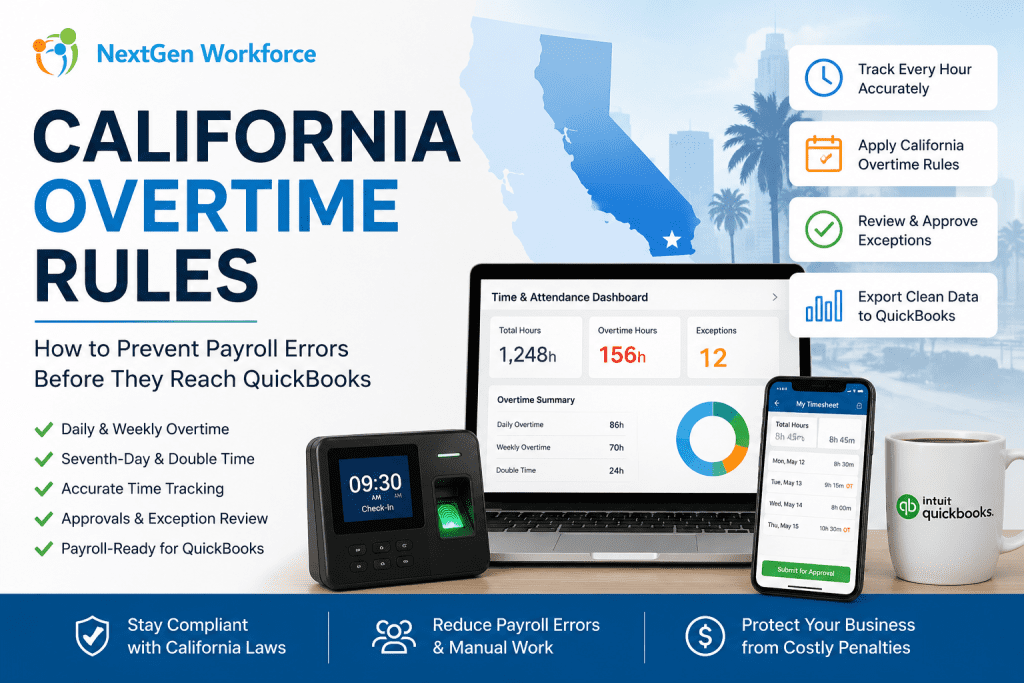
California Overtime Rules: How to Prevent Payroll Errors Before They Reach QuickBooks By NextGen Workforce Editorial Team Last updated: May 2026 California overtime rules can get expensive quickly. California overtime rules require careful review of daily hours, weekly totals, seventh-day work, employee schedules, and payroll approvals. Businesses using QuickBooks need clean, payroll-ready time data before export so overtime, double time, PTO, and attendance exceptions are handled correctly. For many California employers, payroll problems do not start inside QuickBooks. They start earlier. An employee clocks in early. A manager approves a schedule change verbally. A missed punch sits unresolved. A long shift crosses daily overtime. Then payroll arrives, and the team has to fix everything under pressure. That is the real issue. QuickBooks can process payroll, but it depends on the quality of the time data sent into it. If attendance, overtime, PTO, and approvals are not reviewed first, payroll can still become messy. Managing California Overtime Manually? NextGen Workforce helps businesses catch overtime issues before payroll runs. Track time, compare schedules, apply overtime rules, review exceptions, approve timecards, and prepare cleaner payroll-ready data for QuickBooks. See How It Works What Are California Overtime Rules? Quick answer: California overtime rules are more detailed than basic weekly overtime. Many nonexempt employees may qualify for daily overtime, weekly overtime, seventh-day overtime, and double time depending on hours worked and employee classification. Under California guidance, overtime may apply when a nonexempt employee works more than 8 hours in a workday, more than 40 hours in a workweek, or works on the seventh consecutive day in a workweek. California also recognizes double-time situations. This can apply when employees work more than 12 hours in a workday or more than 8 hours on the seventh consecutive day of work in a workweek. That means payroll teams cannot only check weekly totals. They must review daily hours, workweek totals, schedule changes, seventh-day work, and employee classifications. Exemptions and industry-specific rules may also apply, so employers should confirm details with legal counsel or official state guidance. Why California Overtime Creates Payroll Risk Quick answer: California overtime creates payroll risk because small attendance errors can affect regular time, overtime, double time, and payroll export accuracy. Missed punches, late approvals, and schedule changes can lead to incorrect pay categories if they are not reviewed before payroll. California payroll becomes risky when time data is incomplete. A missed clock-out may change daily totals. An early start may trigger overtime. A long shift may create double time. A seventh consecutive workday may need special review. These are not small details for payroll. They affect paychecks, labor cost, employee trust, and compliance exposure. They also create extra work for payroll managers who already have a deadline. California enforcement activity shows why accurate payroll records matter. In 2024, the California Labor Commissioner’s Office announced a $1.7 million wage theft settlement involving more than 550 Wingstop employees in Kern County after an investigation involving wages, overtime, and meal breaks. Manual review makes the problem harder. Payroll teams may need to check spreadsheets, manager notes, timecards, schedules, PTO requests, and QuickBooks export files. When those records do not match, the team has to investigate before payroll can move forward. Key takeaway: California overtime should be reviewed before payroll, not discovered during payroll. What Payroll Teams Should Review Before Running California Payroll Quick answer: Before running California payroll, teams should review missing punches, daily hours, weekly totals, seventh-day work, double-time triggers, PTO, holidays, schedule changes, and manager approvals. This helps reduce corrections before exporting time data to QuickBooks. A strong overtime process starts before payroll day. Payroll teams should not wait until the end of the pay period to discover exceptions. They need a workflow that identifies issues while managers still have time to review them. Missing Punches Missing punches can create incorrect daily totals. If an employee forgets to clock out, the system may not know whether overtime applies. Payroll then has to chase the employee or manager for confirmation. Daily Hours California daily overtime makes daily review important. Even when weekly hours look normal, a single long workday may still create overtime or double time. This is where basic weekly-only reviews can fail. Weekly Totals Weekly overtime still matters. Payroll teams should review total workweek hours and confirm whether overtime categories are separated correctly before export. Seventh-Day Work Seventh-day work needs special attention. If an employee works seven consecutive days in a workweek, payroll should review whether seventh-day overtime or double time applies based on the hours worked. PTO And Holidays PTO and holidays should match the timecard. If approved time off does not appear correctly, payroll teams may have to manually compare records from HR, scheduling, and attendance systems. Manager Approvals Approvals should happen before payroll. Payroll should not depend on emails, text messages, or verbal approval after the pay period closes. Manager review should be part of the timecard workflow. Free Checklist: California Overtime Payroll Audit Checklist Before sending hours to QuickBooks, use a simple checklist to review missing punches, daily overtime, weekly overtime, seventh-day work, PTO, approvals, and export readiness. Review punches: Find missing clock-ins and clock-outs. Check daily hours: Identify days over 8 and 12 hours. Check weekly totals: Review hours over 40 in the workweek. Review seventh-day work: Confirm consecutive-day rules. Confirm approvals: Make sure managers reviewed exceptions. Validate PTO: Match approved time off with timesheets. Prepare export: Confirm earning codes before QuickBooks. Contact for The California Overtime Checklist How Manual Overtime Tracking Breaks Down Quick answer: Manual overtime tracking breaks down when payroll teams rely on spreadsheets, manager memory, email approvals, and last-minute corrections. The risk grows when employees work across multiple locations, shifts, departments, or pay periods. Manual overtime review looks manageable when the team is small. Then the business grows. More employees clock in. More managers approve time. More sites open. More schedules change during the week. That is when manual tracking starts to crack. Spreadsheets drift: One edit can change payroll totals. Emails get buried: