California Meal Premium Automation: Catch 5-Hour and 10-Hour Meal Break Issues Before Payroll
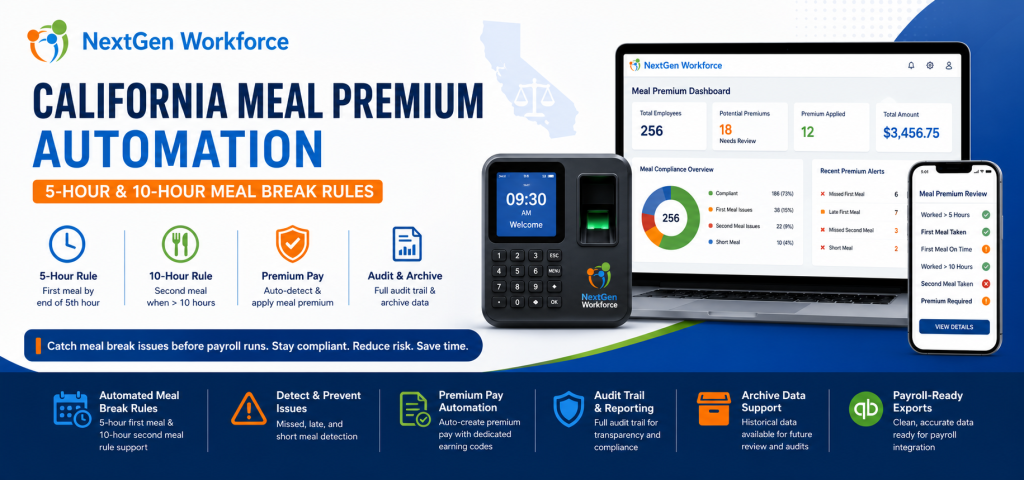
California Meal Premium Automation: Catch 5-Hour and 10-Hour Meal Break Issues Before Payroll By NextGen Workforce Editorial Team Last updated: June 2026 California meal premium errors are usually found too late. California meal premium automation helps employers review first meal, second meal, short meal, missed meal, and late meal issues before payroll runs. For hourly teams, this means payroll can catch 5-hour and 10-hour meal break problems earlier instead of fixing them after timecards are already closed. That is the real payroll problem. California meal period rules are not only a legal policy. They are a daily timecard review workflow. An employee works past the fifth hour without a meal break. Another employee works more than 10 hours and may need a second meal period review. A manager forgets to approve a meal premium. Payroll discovers the issue after the pay period closes. When this review is manual, mistakes are easy to miss. NextGen Workforce is enhancing support and automation for California meal premium workflows, including 5-hour first meal review, 10-hour second meal review, premium pay handling, audit visibility, and archive data for payroll and compliance review. Still Reviewing California Meal Premiums Manually? NextGen Workforce helps businesses detect missed, late, short, first, and second meal break issues before payroll runs. Review meal premium triggers, approvals, audit history, archive data, and payroll-ready premium records in one connected workflow. Talk To An Expert What Is California Meal Premium Pay? Quick answer: California meal premium pay generally applies when an employer does not provide a required meal period. In that situation, the employee may be owed one additional hour of pay at the regular rate for that workday. California meal break compliance matters because the timing and availability of meal periods affect payroll. For many nonexempt employees, a meal period must generally be provided when the work period is more than five hours. The meal period generally must be provided no later than the end of the employee’s fifth hour of work. When an employee works more than 10 hours in a day, a second meal period may also be required. If a required meal period is not provided, meal premium pay may be owed. For payroll teams, this creates a practical problem. They must know whether the employee worked long enough to trigger a meal rule, whether the meal break was taken, whether it was taken on time, whether it was long enough, and whether a premium should be added. Key takeaway: California meal premium review should happen before payroll, not after payroll discovers a missing premium. Why California Meal Premium Errors Happen Quick answer: California meal premium errors happen when timecards, break records, schedules, manager approvals, and payroll codes are reviewed manually or stored in separate systems. Most meal premium issues do not happen because payroll teams are careless. They happen because the workflow is fragmented. A manager may review total hours but not meal timing. Payroll may review overtime but not break length. An employee may have a valid unpaid break, but the break record may be missing. Another employee may work more than 10 hours, but the second meal review may not happen before payroll starts. These problems become harder when teams work long shifts, multiple job sites, changing schedules, or high-volume hourly operations. Manual review creates several risks: Late first meal: The meal may start after the required timing window. Missed meal: No qualifying meal break appears on the timecard. Short meal: The meal break may be shorter than required. Second meal risk: Shifts over 10 hours may need additional review. Duplicate premiums: Payroll may accidentally add the same premium more than once. Missing pay code: Meal premium may not appear under the correct earning code. No audit trail: Managers and payroll may not see who reviewed what. No archive view: Historical records may be hard to verify later. As a result, payroll teams spend time checking records manually instead of starting with clean, reviewed data. The 5-Hour First Meal Rule: Why Timing Matters Quick answer: California meal period review should check whether an employee who works more than five hours received a qualifying meal period no later than the end of the fifth hour, unless a valid exception or waiver applies. The first meal period is one of the most common areas where payroll mistakes happen. It is not enough to know that the employee took a meal break. The system also needs to know when the meal break started, whether it was long enough, and whether the employee’s worked time crossed the rule threshold. For example, if an employee clocks in at 7:00 AM and works a full shift, the system should review whether the first meal period was provided within the expected timing window. When this is done manually, payroll may only see total hours. However, meal premium review requires more than total hours. It requires a time-based check. NextGen Workforce helps automate this review by checking timecard and break data against configured California meal premium rules. The 10-Hour Second Meal Rule: Why It Is Easy To Miss Quick answer: When an employee works more than 10 hours in a day, the timecard may need second meal period review. This is easy to miss when payroll only checks total hours, overtime, or the first meal break. Second meal period review is where manual processes often break down. A long shift may already have overtime. Payroll may focus on regular and overtime categories. Meanwhile, the second meal requirement may not be reviewed carefully. That creates risk. If the employee works more than 10 hours, the system should check whether a second meal period is required, whether it was provided, and whether any waiver or exception applies. NextGen Workforce helps businesses review these 10-hour meal break scenarios before payroll runs. This gives payroll teams better visibility into possible second meal premium issues before timecards are finalized. How NextGen Workforce Automates California Meal Premium Support Quick answer: NextGen Workforce helps automate California meal premium support by reviewing