
Massachusetts Sick Leave Law: How to Track Earned Sick Time Without Manual Payroll Errors
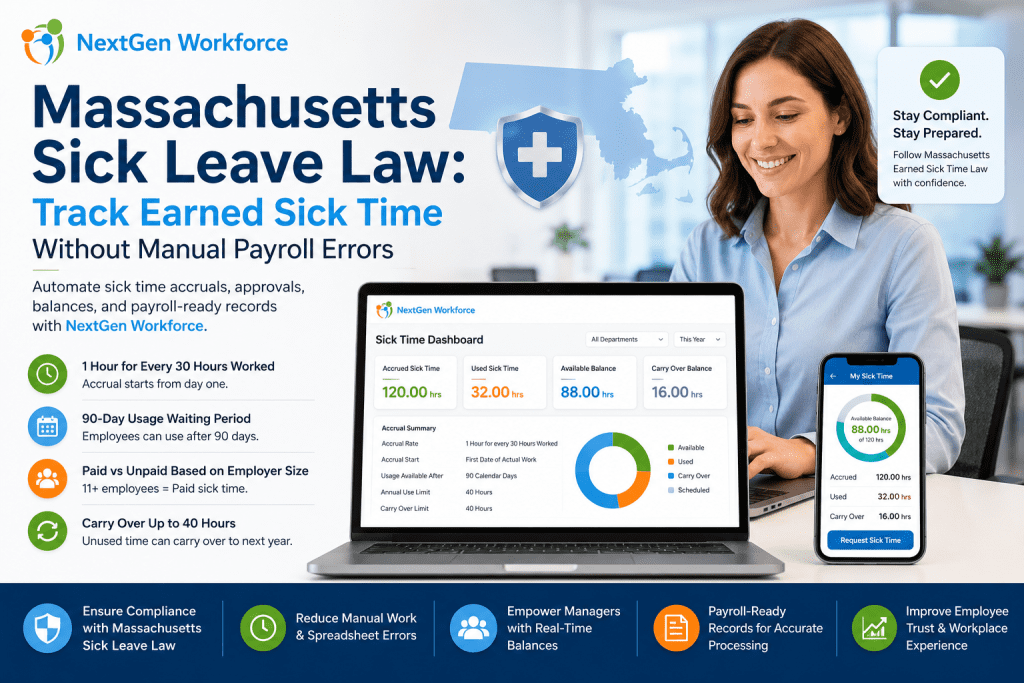
Massachusetts Sick Leave Law: How to Track Earned Sick Time Without Manual Payroll Errors By NextGen Workforce Editorial Team Last updated: May 2026 Massachusetts sick leave tracking looks simple until payroll has to calculate it every pay period. Massachusetts sick leave law requires most employers to provide earned sick time, up to 40 hours per year. Employees generally accrue 1 hour of sick time for every 30 hours worked, and whether that time is paid or unpaid depends on employer headcount. The rule is easy to explain. The tracking is where HR and payroll teams struggle. Part-time employees work different hours. Seasonal employees come and go. New hires start accruing from day one but may not be able to use sick time until later. Carryover needs year-end review. Payroll needs the correct paid or unpaid sick time category. When all of that lives in spreadsheets, email approvals, and manual balance updates, payroll errors become much easier to miss. That is where NextGen Workforce helps. NextGen Workforce connects time tracking, sick time accruals, leave requests, approvals, balance history, and payroll-ready reporting so businesses can manage earned sick time with less manual work. Still Tracking Massachusetts Sick Time Manually? NextGen Workforce helps businesses automate sick time accruals, requests, approvals, balances, and payroll-ready records. Track hours worked, calculate earned sick time, manage eligibility, approve requests, and prepare cleaner payroll records without spreadsheet cleanup. See How It Works What Is The Massachusetts Sick Leave Law? Quick answer: The Massachusetts Earned Sick Time Law gives most workers the right to earn and use job-protected sick time. Employers with 11 or more employees generally must provide paid sick time, while smaller employers must provide sick time that may be unpaid. Massachusetts sick leave law applies broadly to eligible workers whose primary place of work is in Massachusetts. This can include full-time, part-time, seasonal, and temporary employees. For HR teams, the main issue is not only writing the policy. The real work is tracking earned sick time correctly for every employee type. A full-time employee may reach the annual limit quickly. A part-time employee may accrue slowly. A seasonal employee may leave and return. A temporary employee may still count toward employer size calculations depending on the situation. That is why Massachusetts sick leave compliance becomes a workflow problem. You need accurate hours, clear balances, eligibility rules, approval history, and payroll-ready sick time records. How Massachusetts Earned Sick Time Accrual Works Quick answer: Employees generally earn 1 hour of sick time for every 30 hours worked, up to 40 hours per benefit year. Accrual starts on the first date of actual work, but employees generally may begin using accrued sick time after 90 days. Massachusetts sick time accrual depends on hours worked. That means payroll and HR need accurate time records before they can trust the sick leave balance. Accrual Rate Employees generally accrue 1 hour of earned sick time for every 30 hours worked. This includes hours worked toward accrual, and regulations also address different work arrangements such as exempt employees, piece work, and fee-for-service situations. Annual Limit Employees can generally earn and use up to 40 hours of earned sick time per benefit year if they work enough hours. This annual limit matters because payroll should not allow sick time usage beyond the employer’s configured policy and legal requirements. 90-Day Usage Waiting Period Employees generally begin accruing earned sick time from the first date of actual work. However, they may generally begin using accrued earned sick time 90 days after their first date of actual work. Carryover Unused earned sick time may carry over to the next benefit year, up to 40 hours. Employers may still limit annual use to 40 hours, depending on the applicable rules and policy setup. Key takeaway: Massachusetts sick time accrual depends on accurate hours worked. If time tracking is wrong, leave balances can be wrong too. Why Massachusetts Sick Leave Tracking Creates Payroll Risk Quick answer: Massachusetts sick leave tracking creates payroll risk when hours worked, accrual balances, paid or unpaid status, waiting periods, usage limits, and carryover are managed manually. Small tracking errors can turn into payroll corrections and employee disputes. Many businesses understand the law but still struggle with the process. The problem is usually not the policy document. It is the day-to-day tracking. Payroll teams need to know how many hours an employee worked. HR needs to know how much sick time the employee earned. Managers need to know whether the employee has a usable balance. Employees expect their balance to be correct. If those records live in different places, the process breaks down. A sick time request may be approved before eligibility is checked. A part-time employee’s accrual may be miscalculated. A carryover balance may be updated late. Payroll may receive the wrong sick time category. That creates unnecessary manual work. It also creates employee trust issues. Sick time is personal, and employees expect their balance to be accurate when they need it. What HR And Payroll Teams Must Track Manually Quick answer: To manage Massachusetts earned sick time manually, HR and payroll teams must track hire dates, hours worked, accrual earned, usage eligibility, paid or unpaid status, time used, remaining balance, carryover, and payroll categories. This is where spreadsheets become risky. One spreadsheet may track hours. Another may track PTO. A manager may approve time off by email. Payroll may enter the sick time manually later. Each handoff creates room for error. Employer size: Determines paid or unpaid sick time. Employee hire date: Supports the 90-day usage waiting period. Hours worked: Drives sick time accrual. Accrual earned: Shows available sick time. Sick time used: Reduces the employee balance. Remaining balance: Helps managers approve requests. Carryover balance: Supports year-end tracking. Paid or unpaid status: Affects payroll processing. Documentation rules: Helps HR apply policy consistently. Payroll category: Ensures the correct earning code is used. If even one item is tracked separately, payroll may receive the wrong information. NextGen Workforce helps reduce that risk by connecting