Grant Time Tracking Software for Multi-Level Funding, Projects, Activities, and Outcomes
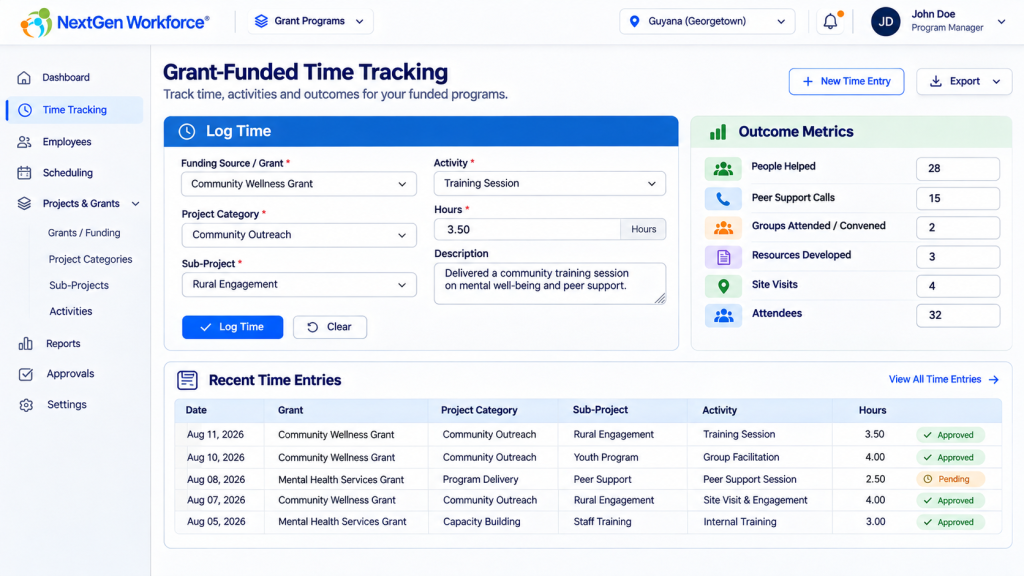
Grant Time Tracking Software for Multi-Level Funding, Projects, Activities, and Outcomes Grant-funded organizations rarely need to track time at only one level. An employee may need to select a funding source, then a project category, then a sub-project, then an activity. On top of that, the organization may need to record outcomes such as people helped, site visits, support calls, resources developed, or groups attended. That creates a very different time-tracking problem from a simple project-and-task setup. The question is no longer just: How many hours did this employee work? It becomes: Which grant funded the time? Which project category did the work belong to? Which sub-project was involved? What activity was performed? What outcomes were produced? Can the same activity be reported across multiple grants? Can the organization still see the original funding source behind every hour? NextGen Workforce is designed for organizations that need more flexibility in how workforce time is structured, captured, and reported. Tracking Grant Hours Across More Than Project and Task? Show us how your grants, projects, activities, and outcomes are structured. We can review whether NextGen Workforce can support the reporting model you need. Review Your Grant Tracking Workflow What Is Grant Time Tracking Software? Grant time tracking software helps organizations record employee labor against the funding source or program that supported the work. For a simple organization, that might mean choosing one grant and entering hours. For a more complex organization, the structure may look like this: Funding Source / Grant ↓ Project Category ↓ Sub-Project ↓ Activity ↓ Hours ↓ Outcome Metrics Each level adds reporting context. The funding source explains where the money came from. The project category explains the broader area of work. The sub-project identifies the specific initiative. The activity explains what the employee actually did. The outcome metrics show what that work produced. Grant reporting becomes much easier when the hours and the outcomes live in the same reporting structure. Why Project and Task May Not Be Enough Many time-tracking systems are built around a simple hierarchy: Project ↓ Task ↓ Hours That works well for many businesses. But grant-funded organizations may have several layers between the funding source and the work being performed. For example: Grant ↓ Project Category ↓ Sub-Project ↓ Activity ↓ Outcome If the software only supports project and task, the organization may end up flattening its structure or maintaining additional information somewhere else. That usually creates one of two problems: The time entry loses important grant-reporting detail. The additional detail is stored separately and is no longer directly connected to the hours. The second problem is especially important. If outcome information is entered in a separate table or system, the organization may know that 25 people were helped and separately know that 3.5 hours were worked, but still have to reconstruct the relationship between the two when preparing a report. A Practical Multi-Level Grant Tracking Example Consider this time entry: Funding Source / Grant B-101 – Community Wellness Grant Project Category Community Outreach Sub-Project Rural Engagement Activity Training Session Hours 3.50 The organization may also want to capture outcomes for the same entry: Outcome Metric Value People Helped 25 Peer Support Calls 4 State and Local Groups Attended or Convened 2 Resources Developed 1 Site Visits 2 Peer Support Call Attendees 18 Now the organization can answer a much more useful question: What work was performed, under which grant, for how long, and what did that work produce? Track Funding Sources Without Duplicating the Whole Reporting Model One of the harder grant-reporting problems appears when the same activity exists under multiple grants. Imagine this: Grant A ↓ Community Outreach ↓ Rural Engagement ↓ Training Session Grant B ↓ Community Outreach ↓ Rural Engagement ↓ Training Session The organization still needs the grant-specific allocation. But it may also need to know: How many total hours did we spend on Training Sessions across all grants? If every activity is treated as an isolated value under each grant, reporting that answer can become awkward. A more flexible model treats the activity as a shared reporting dimension while preserving the funding source behind each time entry. That makes both views possible: Hours by grant Hours by activity across all grants Can You Report the Same Activity Across Multiple Grants? Yes, if the reporting model separates the funding source from the activity dimension. For example: Grant Activity Hours Grant A Peer Support Call 12 Grant B Peer Support Call 18 Grant C Peer Support Call 9 The organization can still report each grant separately. But it can also report: Peer Support Call = 39 total hours across all grants. This is a small modeling decision with a big reporting impact. Why Shared Activities Matter Grant structures often repeat the same kinds of work. For example: Training Session Community Outreach Peer Support Call Site Visit Group Meeting Resource Development Policy and Advocacy If those activities are recreated separately under every funding source, the organization may eventually have dozens of duplicated values that all mean the same thing. That makes reporting harder than it needs to be. Using shared activity codes can make it easier to answer questions such as: How much time was spent on peer support across the organization? How many hours went into training sessions this quarter? Which grants funded site visits? How much labor was allocated to community outreach? Outcome Metrics Should Be Tied to the Work Grant reporting often goes beyond labor hours. A funder may want to understand what happened because of those hours. That can include metrics such as: People helped Participants served Peer support calls Groups attended Groups convened Resources developed Site visits Training sessions Attendees Other program-specific outcomes When those metrics are connected to the time entry, the organization can report labor and program outcomes together. That is much more useful than maintaining one system for hours and another table for outcomes. Example: Hours and Outcomes in One Record A single record might contain: Date: April 16 Grant: Community Wellness