QuickBooks Time Alternative for Complex Attendance Rules
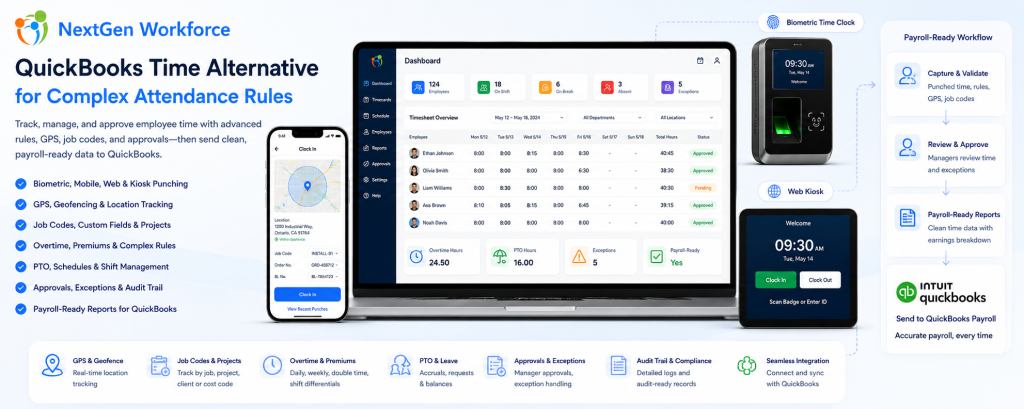
QuickBooks Time Alternative for Complex Attendance Rules By NextGen Workforce Editorial Team Last updated: August 2026 QuickBooks users do not always need another payroll tool. Many businesses need cleaner, approved, payroll-ready time data before payroll starts. If your team is still fixing missing punches, overtime, PTO, job codes, manager approvals, geofence exceptions, or custom attendance rules before processing payroll in QuickBooks, the real issue may be the time tracking workflow before payroll. QuickBooks is strong for accounting and payroll workflows. However, payroll accuracy depends on the data that reaches QuickBooks. If employee hours are incomplete, unapproved, or categorized incorrectly, payroll teams still have to clean up the records manually. That is where NextGen Workforce helps. NextGen Workforce supports businesses that use QuickBooks but need more flexible time tracking, biometric attendance, mobile GPS clock-in, geofencing, web kiosk punching, custom punch fields, complex overtime rules, PTO, approvals, audit-ready records, and payroll-ready reports. Using QuickBooks But Still Fixing Timesheets Manually? NextGen Workforce helps businesses prepare clean, reviewed, and payroll-ready time data before payroll runs. Track punches, schedules, overtime, PTO, approvals, job codes, GPS locations, geofence exceptions, and custom rules in one connected workflow. QuickBooks Time Tracking Demo Why Businesses Look for a QuickBooks Time Alternative Quick answer: Businesses often look for a QuickBooks Time alternative when their attendance rules, field tracking needs, biometric clock requirements, job codes, approvals, or payroll workflows are more complex than a basic time tracking setup. For simple teams, basic time tracking may be enough. Employees clock in, managers review hours, and payroll processes the records. However, many businesses using QuickBooks have more complex workforce requirements. They may need to track field employee locations, enforce jobsite geofences, capture custom fields, apply daily and weekly overtime, manage PTO, approve exceptions, handle shift premiums, track web kiosk punches, or support biometric devices. When those details are not handled before payroll, QuickBooks receives data that still needs work. That creates payroll cleanup. Missing punches: Payroll has to chase employees or managers. Unapproved overtime: Extra hours are discovered too late. PTO mismatches: Approved leave does not match the timesheet. Wrong earning codes: Regular, overtime, holiday, and premium hours need correction. Job code gaps: Project, department, client, or cost code details are missing. Field punch issues: Mobile employees clock in from different locations without enough visibility. Custom rule gaps: Company-specific attendance rules still need spreadsheet work. In practice, the problem is not always payroll. The problem is that time data is not payroll-ready before it reaches payroll. QuickBooks Can Process Payroll, But It Cannot Fix Messy Time Data Quick answer: QuickBooks can help process payroll, but payroll accuracy depends on complete, approved, and correctly categorized time records. NextGen Workforce helps prepare that data before payroll starts. Payroll teams need more than total hours. They need time records that are complete, approved, categorized, and ready for payroll review. Before data reaches QuickBooks, businesses often need to confirm: Did every employee clock in and out? Did managers approve the timecard? Was overtime calculated correctly? Was PTO or sick time included? Were holiday hours categorized properly? Were shift premiums or differentials applied? Were job codes, project codes, or custom fields captured? Were GPS or geofence exceptions reviewed? Were payroll earning categories mapped correctly? If these items are not reviewed before payroll, payroll teams still need manual cleanup. NextGen Workforce helps move that cleanup earlier in the workflow. Key takeaway: The goal is not just to track time. The goal is to prepare clean, approved, payroll-ready time data before QuickBooks payroll processing. How NextGen Workforce Supports QuickBooks Payroll-Ready Workflows Quick answer: NextGen Workforce helps businesses capture employee time, apply attendance rules, review exceptions, approve timecards, and prepare payroll-ready reports before data reaches QuickBooks. NextGen Workforce is built for businesses that need more than a simple clock-in screen. The workflow can support different teams, different attendance methods, and different payroll requirements. Step 1: Employees Clock In Employees can clock in using mobile, web kiosk, biometric hardware, or other supported attendance workflows. This gives businesses flexibility based on the type of workforce. Step 2: Required Details Are Captured Where needed, the system can capture GPS location, geofence status, job code, project, department, work location, Order No., BL No., task, or notes during punch workflows. This is useful for field teams, construction crews, heavy machinery companies, service teams, and project-based businesses. Step 3: Attendance Rules Are Applied NextGen Workforce can support configurable attendance rules such as overtime, double time, shift differentials, rounding, grace periods, meal rules, auto clock-out, holiday rules, and customer-specific policies. Step 4: Exceptions Are Reviewed Managers and payroll teams can review missing punches, late clock-ins, early departures, overtime warnings, geofence issues, incomplete custom fields, or timecard exceptions. Step 5: Managers Approve Timecards Approval workflows help ensure time records are reviewed before payroll starts. This reduces the need for payroll teams to chase managers at the end of the pay period. Step 6: Payroll-Ready Reports Are Prepared After review, NextGen Workforce helps prepare regular hours, overtime, double time, PTO, sick time, holiday hours, shift premiums, job codes, and other payroll-ready data. Step 7: QuickBooks Receives Cleaner Data Payroll starts with reviewed, categorized, and more reliable time records. This helps reduce spreadsheet cleanup before payroll processing. Need More Than Basic Time Tracking for QuickBooks? NextGen Workforce helps businesses manage biometric time clocks, mobile GPS clock-in, geofencing, web kiosk punching, custom punch fields, overtime rules, PTO, approvals, and payroll-ready reports. Talk To An Expert When Basic Time Tracking Is Not Enough Quick answer: Basic time tracking is often not enough when a business needs biometric verification, mobile GPS tracking, geofencing, custom punch fields, complex overtime, PTO workflows, shift premiums, or approval rules before QuickBooks payroll. Many businesses start with simple time tracking. That works until the workforce becomes more complex. Then payroll teams need more context around each punch. Business Need Why Basic Time Tracking Struggles How NextGen Workforce Helps Biometric attendance PINs or manual entry may not verify identity strongly enough Supports biometric time clock workflows Mobile field teams
California Meal Premium Automation: Catch 5-Hour and 10-Hour Meal Break Issues Before Payroll
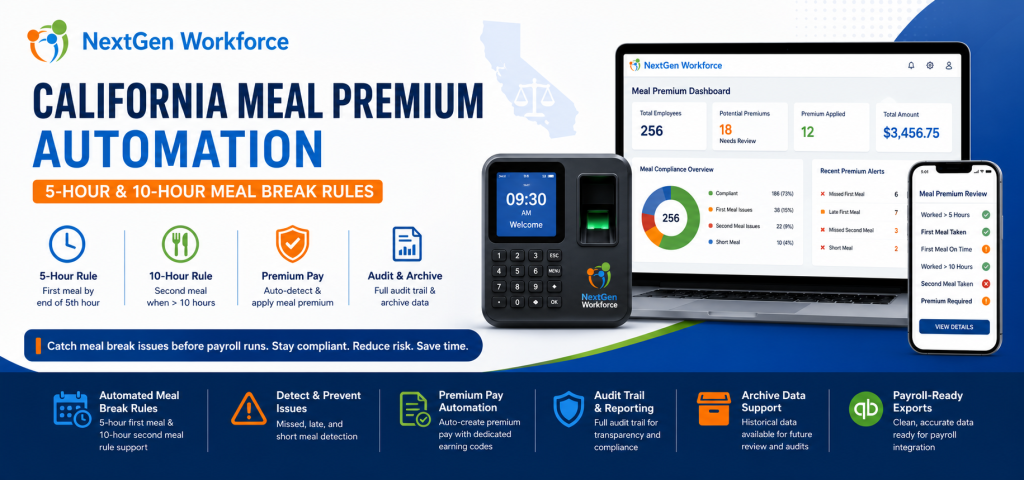
California Meal Premium Automation: Catch 5-Hour and 10-Hour Meal Break Issues Before Payroll By NextGen Workforce Editorial Team Last updated: June 2026 California meal premium errors are usually found too late. California meal premium automation helps employers review first meal, second meal, short meal, missed meal, and late meal issues before payroll runs. For hourly teams, this means payroll can catch 5-hour and 10-hour meal break problems earlier instead of fixing them after timecards are already closed. That is the real payroll problem. California meal period rules are not only a legal policy. They are a daily timecard review workflow. An employee works past the fifth hour without a meal break. Another employee works more than 10 hours and may need a second meal period review. A manager forgets to approve a meal premium. Payroll discovers the issue after the pay period closes. When this review is manual, mistakes are easy to miss. NextGen Workforce is enhancing support and automation for California meal premium workflows, including 5-hour first meal review, 10-hour second meal review, premium pay handling, audit visibility, and archive data for payroll and compliance review. Still Reviewing California Meal Premiums Manually? NextGen Workforce helps businesses detect missed, late, short, first, and second meal break issues before payroll runs. Review meal premium triggers, approvals, audit history, archive data, and payroll-ready premium records in one connected workflow. Talk To An Expert What Is California Meal Premium Pay? Quick answer: California meal premium pay generally applies when an employer does not provide a required meal period. In that situation, the employee may be owed one additional hour of pay at the regular rate for that workday. California meal break compliance matters because the timing and availability of meal periods affect payroll. For many nonexempt employees, a meal period must generally be provided when the work period is more than five hours. The meal period generally must be provided no later than the end of the employee’s fifth hour of work. When an employee works more than 10 hours in a day, a second meal period may also be required. If a required meal period is not provided, meal premium pay may be owed. For payroll teams, this creates a practical problem. They must know whether the employee worked long enough to trigger a meal rule, whether the meal break was taken, whether it was taken on time, whether it was long enough, and whether a premium should be added. Key takeaway: California meal premium review should happen before payroll, not after payroll discovers a missing premium. Why California Meal Premium Errors Happen Quick answer: California meal premium errors happen when timecards, break records, schedules, manager approvals, and payroll codes are reviewed manually or stored in separate systems. Most meal premium issues do not happen because payroll teams are careless. They happen because the workflow is fragmented. A manager may review total hours but not meal timing. Payroll may review overtime but not break length. An employee may have a valid unpaid break, but the break record may be missing. Another employee may work more than 10 hours, but the second meal review may not happen before payroll starts. These problems become harder when teams work long shifts, multiple job sites, changing schedules, or high-volume hourly operations. Manual review creates several risks: Late first meal: The meal may start after the required timing window. Missed meal: No qualifying meal break appears on the timecard. Short meal: The meal break may be shorter than required. Second meal risk: Shifts over 10 hours may need additional review. Duplicate premiums: Payroll may accidentally add the same premium more than once. Missing pay code: Meal premium may not appear under the correct earning code. No audit trail: Managers and payroll may not see who reviewed what. No archive view: Historical records may be hard to verify later. As a result, payroll teams spend time checking records manually instead of starting with clean, reviewed data. The 5-Hour First Meal Rule: Why Timing Matters Quick answer: California meal period review should check whether an employee who works more than five hours received a qualifying meal period no later than the end of the fifth hour, unless a valid exception or waiver applies. The first meal period is one of the most common areas where payroll mistakes happen. It is not enough to know that the employee took a meal break. The system also needs to know when the meal break started, whether it was long enough, and whether the employee’s worked time crossed the rule threshold. For example, if an employee clocks in at 7:00 AM and works a full shift, the system should review whether the first meal period was provided within the expected timing window. When this is done manually, payroll may only see total hours. However, meal premium review requires more than total hours. It requires a time-based check. NextGen Workforce helps automate this review by checking timecard and break data against configured California meal premium rules. The 10-Hour Second Meal Rule: Why It Is Easy To Miss Quick answer: When an employee works more than 10 hours in a day, the timecard may need second meal period review. This is easy to miss when payroll only checks total hours, overtime, or the first meal break. Second meal period review is where manual processes often break down. A long shift may already have overtime. Payroll may focus on regular and overtime categories. Meanwhile, the second meal requirement may not be reviewed carefully. That creates risk. If the employee works more than 10 hours, the system should check whether a second meal period is required, whether it was provided, and whether any waiver or exception applies. NextGen Workforce helps businesses review these 10-hour meal break scenarios before payroll runs. This gives payroll teams better visibility into possible second meal premium issues before timecards are finalized. How NextGen Workforce Automates California Meal Premium Support Quick answer: NextGen Workforce helps automate California meal premium support by reviewing
Canada Overtime Rules: Why Time Tracking Software Needs Flexible Attendance Rules
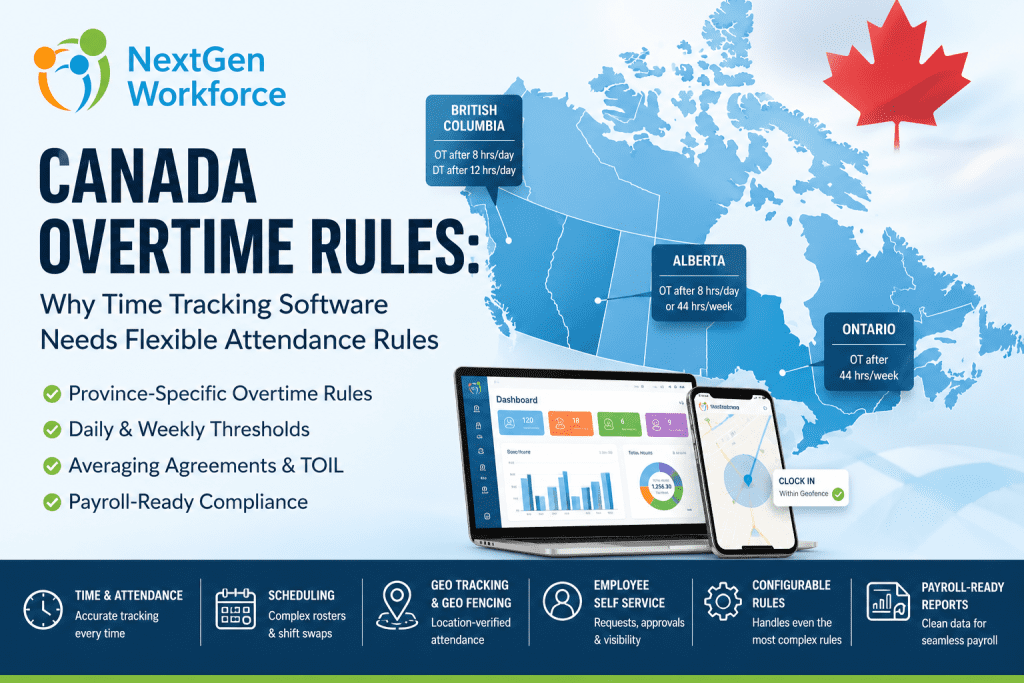
Canada Overtime Rules: Why Time Tracking Software Needs Flexible Attendance Rules By NextGen Workforce Editorial Team Last updated: June 2026 Canada overtime rules are not one-size-fits-all. Canada overtime rules depend on jurisdiction, province, industry, employee classification, union agreements, averaging agreements, and employment contracts. A rule that works for Ontario may not work for Alberta, British Columbia, or a federally regulated workplace. That creates a real problem for HR and payroll teams. In practice, they are not only tracking hours. They are also tracking the rule behind those hours. One employee may trigger weekly overtime. Another may trigger daily overtime. A third may work under an averaging agreement. Meanwhile, another employee may bank overtime as time off in lieu. For field teams, the workflow can get even more complex. A mobile employee may need GPS validation, while a manager may approve a schedule change that creates overtime without realizing it. When this is handled manually, payroll becomes reactive. That is why NextGen Workforce helps businesses manage this complexity with configurable attendance rules, time tracking, scheduling, geofencing, alerts, approvals, employee self-service, and payroll-ready reporting. Still Tracking Canadian Overtime Manually? NextGen Workforce helps businesses configure attendance rules by province, policy, employee group, location, and payroll setup. Track time, manage schedules, apply complex overtime rules, review exceptions, approve timecards, and prepare cleaner payroll-ready reports before payroll runs. Talk To An Expert There Is No Single Standard Canada Overtime Rule Quick answer: Canada does not have one universal overtime rule for every employer. Federal labour standards apply to federally regulated workplaces, while most employers follow provincial or territorial employment standards based on where employees work. This is the first mistake many employers make. They try to configure one overtime rule for every Canadian employee. That may work for a very small team in one province. However, it does not work well for businesses with multi-province teams, field employees, different employee groups, union agreements, or multiple pay policies. Federally regulated workplaces follow federal labour standards. These may apply to industries such as banking, airlines, telecommunications, broadcasting, and interprovincial transportation. Most other employers follow provincial or territorial employment standards. As a result, the system must first know which rule applies before it can calculate overtime correctly. Key takeaway: Canadian overtime configuration should start with jurisdiction. Federal and provincial rules cannot be treated as one standard setup. Canada Overtime Rules By Province: Why Thresholds Change Quick answer: Canadian overtime thresholds vary by province. Ontario commonly applies overtime after 44 hours in a work week, Alberta uses an 8/44 rule, and British Columbia applies daily overtime after 8 hours and double time after 12 hours in a day. This is why flexible attendance rules matter. If the system only checks weekly hours, it may miss daily overtime in provinces where daily overtime applies. However, if the system only checks daily overtime, it may miss weekly overtime. In addition, if the system checks both without proper logic, it may double-count hours. Jurisdiction Common Overtime Trigger Why It Matters Federal Standard hours generally reference 8/day and 40/week Applies to federally regulated workplaces Ontario Generally after 44 hours in a work week Weekly overtime tracking is critical Alberta Over 8/day or 44/week, whichever is greater Daily and weekly thresholds must both be reviewed British Columbia After 8/day; double time after 12/day Daily overtime and double time need automation These are only examples. Rules can also vary by industry, role, agreement, exemption, and specific working arrangement. Therefore, employers should always confirm current requirements using official sources or qualified counsel. Why Manual Overtime Tracking Breaks Down In Canada Quick answer: Manual overtime tracking breaks down when payroll teams manage different rules across provinces, schedules, agreements, employee types, and locations. Spreadsheets cannot reliably apply daily overtime, weekly overtime, averaging periods, banked time, statutory holiday premiums, and approvals together. Manual tracking usually starts with good intentions. However, the process becomes harder as the workforce grows. A manager changes a shift. An employee works in another province. A team uses an averaging agreement. A holiday falls inside the pay period. Meanwhile, another employee chooses banked time instead of paid overtime. A field employee clocks in from the wrong location. Each exception creates another payroll review item. Province rules: Payroll checks each location manually. Daily overtime: Long shifts need separate review. Weekly overtime: Totals must be checked before payroll. Double time: Premium hours need correct categories. Averaging: Multi-week cycles create manual math. Banked time: Overtime may become paid time off. Stat holidays: Holiday premiums need separate tracking. Approvals: Managers must review exceptions early. Payroll teams should not be rebuilding the rule logic every pay period. Instead, they need a system that applies the right rule at the right time. How NextGen Workforce Helps Solve HR And Payroll Concerns Quick answer: NextGen Workforce helps HR, payroll, and operations teams manage complex workforce rules in one connected system. Instead of tracking schedules, attendance, overtime, leave, approvals, GPS records, and payroll data manually, businesses can configure workflows that match their real policies. Canadian workforce management is rarely simple. One company may have employees in different provinces. Another may manage union rules, averaging agreements, banked overtime, statutory holidays, rotating schedules, field teams, and different pay periods. That is where many standard systems become difficult to use. They may work for basic time tracking. However, they often struggle when a customer has complex attendance rules, custom overtime logic, special approvals, shift premiums, or multi-location scheduling requirements. NextGen Workforce is built with flexibility at the center. The platform supports HRMS workflows, employee self-service, time and attendance, scheduling, shift swapping, geo-tracking, geo-fencing, alerts, approvals, and payroll-ready reporting in one connected workflow. Complete HRMS And Employee Self-Service Employees should not need to contact HR for every basic request. With NextGen Workforce, employees can access self-service tools for attendance, schedules, time-off requests, approvals, and personal workforce information. As a result, HR teams reduce manual follow-up while employees get better visibility. Time And Attendance With Payroll Accuracy Payroll accuracy starts with clean attendance data. NextGen Workforce time