Why Payroll Errors Happen (And How to Prevent Them Before Payroll Runs)
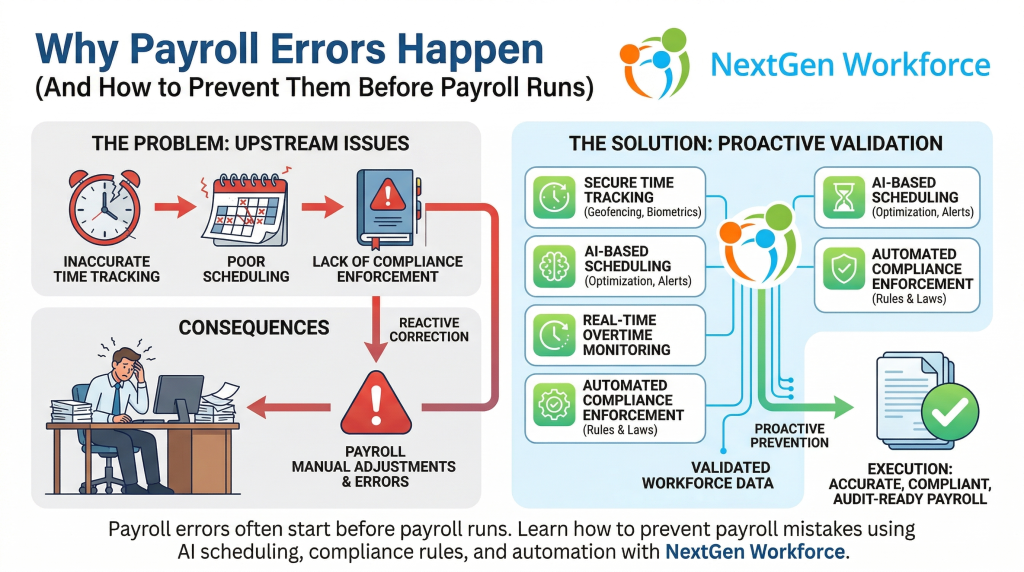
Summary Payroll errors are rarely caused by payroll software. Most payroll mistakes originate from inaccurate time tracking, poor scheduling, and lack of compliance enforcement. Businesses can prevent payroll errors by using systems that validate workforce data before payroll processing. NextGen Workforce combines time tracking, scheduling, compliance rules, and automation to ensure accurate and audit-ready payroll. Introduction Payroll is one of the most critical functions in any organization. But despite using modern payroll systems, many businesses still face: incorrect employee hours overtime miscalculations missed compliance rules manual adjustments during payroll processing The assumption is often that payroll software is the problem. In reality, payroll errors usually happen before payroll even begins. What Causes Payroll Errors? Payroll errors are typically the result of upstream issues. 1. Inaccurate Time Tracking If employee work hours are not captured accurately, payroll calculations will be wrong. Common issues include: missed clock-ins or clock-outs manual time edits buddy punching or proxy attendance lack of real-time validation When inaccurate data enters payroll, errors become unavoidable. 2. Poor Scheduling Practices Scheduling directly impacts payroll. Without proper scheduling controls: employees may exceed daily or weekly limits overtime may go unnoticed until payroll shifts may be assigned without considering compliance rules Scheduling mistakes lead to payroll corrections later. 3. Overtime Mismanagement Overtime is one of the biggest contributors to payroll errors. Businesses often struggle with: tracking weekly vs daily overtime identifying when employees cross thresholds managing unexpected overtime Without proactive monitoring, overtime issues surface during payroll processing. 4. Lack of Compliance Enforcement Labor laws vary by region and can include: overtime regulations meal and rest break requirements shift length rules If these rules are not enforced during scheduling and attendance tracking, payroll teams are left to fix issues manually. 5. Manual Adjustments During Payroll When systems do not validate data in advance, payroll teams must: review timesheets manually correct errors adjust hours verify compliance This increases processing time and creates room for human error. What Is the Real Problem? The real issue is not payroll software. It is the lack of data validation before payroll processing. Most businesses treat payroll as the point of correction. Instead, payroll should be the point of execution. How to Prevent Payroll Errors Before Payroll Runs To eliminate payroll errors, businesses must shift from reactive correction to proactive validation. 1. Use Accurate Time Tracking Systems Implement systems that ensure: real-time clock-in validation biometric or secure attendance tracking location-based verification (geofencing) automatic logging of work hours Accurate input leads to accurate payroll. 2. Optimize Scheduling Before Shifts Begin Scheduling should consider: employee availability labor rules overtime thresholds workload distribution Preventing issues at the scheduling stage reduces payroll corrections later. 3. Monitor Overtime in Real Time Instead of detecting overtime during payroll: track employee hours continuously receive alerts before thresholds are crossed adjust schedules proactively This helps control labor costs and avoid last-minute adjustments. 4. Enforce Compliance Automatically Use systems that apply labor rules automatically, such as: overtime calculations break requirements shift restrictions Automation reduces dependency on manual checks. 5. Integrate Scheduling, Attendance, and Payroll Disconnected systems create gaps. An integrated approach ensures: scheduling aligns with attendance attendance data flows into payroll accurately compliance rules are consistently applied This creates a single source of truth. What Is AI Employee Scheduling’s Role in Payroll Accuracy? AI employee scheduling helps prevent payroll issues before they occur. It does this by: analyzing workforce data identifying overtime risks optimizing shift assignments ensuring compliance during scheduling Instead of reacting to errors, businesses can avoid them entirely. How NextGen Workforce Helps Prevent Payroll Errors NextGen Workforce is designed to eliminate payroll errors at the source. The platform combines: AI-based employee scheduling biometric time tracking geofencing and real-time attendance validation automated compliance rules intelligent timesheet review payroll-ready data processing This ensures that by the time payroll runs: the data is already accurate, compliant, and validated. The Human Impact of Payroll Errors Behind every payroll error is a person. A payroll manager working late to fix discrepancies.An HR leader dealing with employee complaints.A business owner worrying about compliance penalties. Preventing payroll errors is not just about efficiency. It is about reducing stress, improving trust, and ensuring confidence in every payroll cycle. Final Thoughts Payroll errors are not a payroll problem. They are a workforce management problem. Businesses that focus on accurate time tracking, optimized scheduling, compliance automation, and integrated systems can eliminate most payroll issues before payroll runs. This is where modern workforce platforms like NextGen Workforce create real value. Frequently Asked Questions Why do payroll errors happen? Payroll errors usually happen due to inaccurate time tracking, poor scheduling, overtime mismanagement, and lack of compliance enforcement before payroll processing. Can scheduling impact payroll accuracy? Yes. Scheduling decisions directly affect employee hours, overtime, and compliance, which all influence payroll outcomes. How can businesses reduce payroll errors? Businesses can reduce payroll errors by using integrated systems that validate time tracking, scheduling, and compliance before payroll runs. What role does AI play in payroll accuracy? AI helps analyze workforce data, optimize scheduling, detect overtime risks, and ensure compliance, reducing errors before payroll processing.