Why Payroll Errors Happen (And How to Prevent Them Before Payroll Runs)
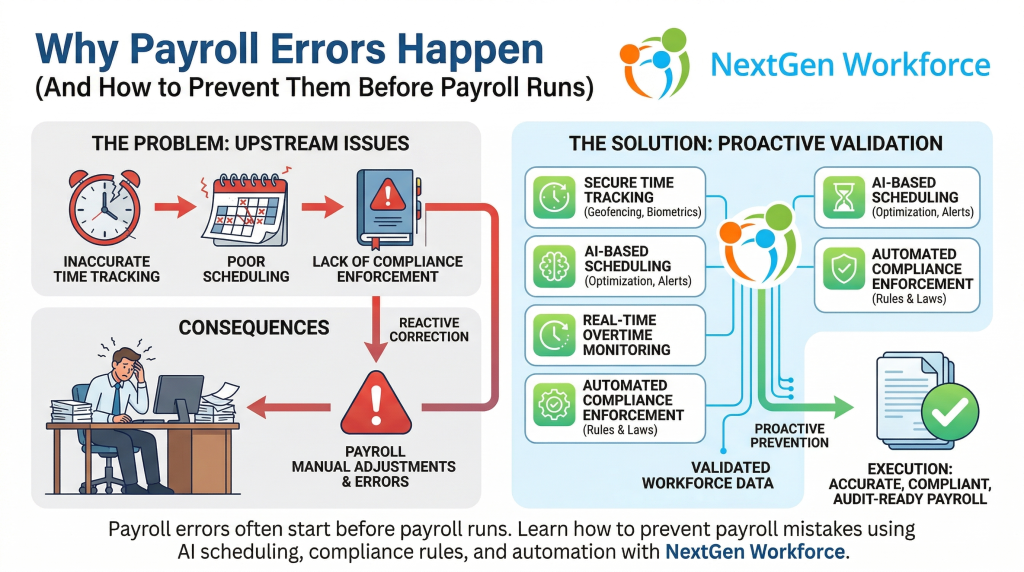
Summary Payroll errors are rarely caused by payroll software. Most payroll mistakes originate from inaccurate time tracking, poor scheduling, and lack of compliance enforcement. Businesses can prevent payroll errors by using systems that validate workforce data before payroll processing. NextGen Workforce combines time tracking, scheduling, compliance rules, and automation to ensure accurate and audit-ready payroll. Introduction Payroll is one of the most critical functions in any organization. But despite using modern payroll systems, many businesses still face: incorrect employee hours overtime miscalculations missed compliance rules manual adjustments during payroll processing The assumption is often that payroll software is the problem. In reality, payroll errors usually happen before payroll even begins. What Causes Payroll Errors? Payroll errors are typically the result of upstream issues. 1. Inaccurate Time Tracking If employee work hours are not captured accurately, payroll calculations will be wrong. Common issues include: missed clock-ins or clock-outs manual time edits buddy punching or proxy attendance lack of real-time validation When inaccurate data enters payroll, errors become unavoidable. 2. Poor Scheduling Practices Scheduling directly impacts payroll. Without proper scheduling controls: employees may exceed daily or weekly limits overtime may go unnoticed until payroll shifts may be assigned without considering compliance rules Scheduling mistakes lead to payroll corrections later. 3. Overtime Mismanagement Overtime is one of the biggest contributors to payroll errors. Businesses often struggle with: tracking weekly vs daily overtime identifying when employees cross thresholds managing unexpected overtime Without proactive monitoring, overtime issues surface during payroll processing. 4. Lack of Compliance Enforcement Labor laws vary by region and can include: overtime regulations meal and rest break requirements shift length rules If these rules are not enforced during scheduling and attendance tracking, payroll teams are left to fix issues manually. 5. Manual Adjustments During Payroll When systems do not validate data in advance, payroll teams must: review timesheets manually correct errors adjust hours verify compliance This increases processing time and creates room for human error. What Is the Real Problem? The real issue is not payroll software. It is the lack of data validation before payroll processing. Most businesses treat payroll as the point of correction. Instead, payroll should be the point of execution. How to Prevent Payroll Errors Before Payroll Runs To eliminate payroll errors, businesses must shift from reactive correction to proactive validation. 1. Use Accurate Time Tracking Systems Implement systems that ensure: real-time clock-in validation biometric or secure attendance tracking location-based verification (geofencing) automatic logging of work hours Accurate input leads to accurate payroll. 2. Optimize Scheduling Before Shifts Begin Scheduling should consider: employee availability labor rules overtime thresholds workload distribution Preventing issues at the scheduling stage reduces payroll corrections later. 3. Monitor Overtime in Real Time Instead of detecting overtime during payroll: track employee hours continuously receive alerts before thresholds are crossed adjust schedules proactively This helps control labor costs and avoid last-minute adjustments. 4. Enforce Compliance Automatically Use systems that apply labor rules automatically, such as: overtime calculations break requirements shift restrictions Automation reduces dependency on manual checks. 5. Integrate Scheduling, Attendance, and Payroll Disconnected systems create gaps. An integrated approach ensures: scheduling aligns with attendance attendance data flows into payroll accurately compliance rules are consistently applied This creates a single source of truth. What Is AI Employee Scheduling’s Role in Payroll Accuracy? AI employee scheduling helps prevent payroll issues before they occur. It does this by: analyzing workforce data identifying overtime risks optimizing shift assignments ensuring compliance during scheduling Instead of reacting to errors, businesses can avoid them entirely. How NextGen Workforce Helps Prevent Payroll Errors NextGen Workforce is designed to eliminate payroll errors at the source. The platform combines: AI-based employee scheduling biometric time tracking geofencing and real-time attendance validation automated compliance rules intelligent timesheet review payroll-ready data processing This ensures that by the time payroll runs: the data is already accurate, compliant, and validated. The Human Impact of Payroll Errors Behind every payroll error is a person. A payroll manager working late to fix discrepancies.An HR leader dealing with employee complaints.A business owner worrying about compliance penalties. Preventing payroll errors is not just about efficiency. It is about reducing stress, improving trust, and ensuring confidence in every payroll cycle. Final Thoughts Payroll errors are not a payroll problem. They are a workforce management problem. Businesses that focus on accurate time tracking, optimized scheduling, compliance automation, and integrated systems can eliminate most payroll issues before payroll runs. This is where modern workforce platforms like NextGen Workforce create real value. Frequently Asked Questions Why do payroll errors happen? Payroll errors usually happen due to inaccurate time tracking, poor scheduling, overtime mismanagement, and lack of compliance enforcement before payroll processing. Can scheduling impact payroll accuracy? Yes. Scheduling decisions directly affect employee hours, overtime, and compliance, which all influence payroll outcomes. How can businesses reduce payroll errors? Businesses can reduce payroll errors by using integrated systems that validate time tracking, scheduling, and compliance before payroll runs. What role does AI play in payroll accuracy? AI helps analyze workforce data, optimize scheduling, detect overtime risks, and ensure compliance, reducing errors before payroll processing.
Detecting and Preventing Attendance Irregularities Before They Happen
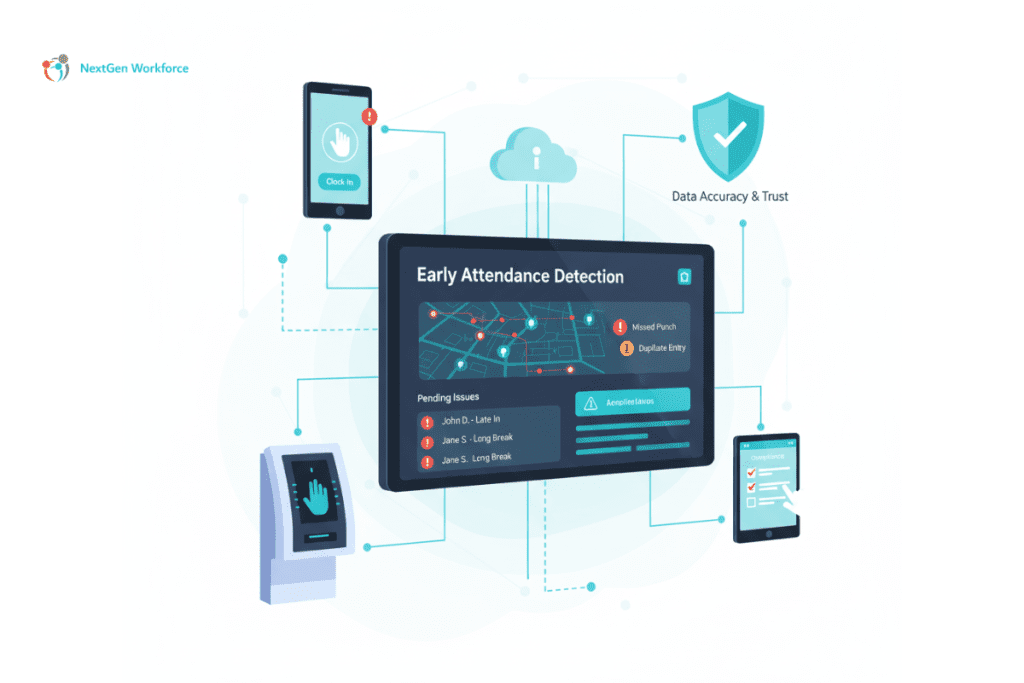
In today’s dynamic workplaces, where employees clock in from offices, job sites, and even mobile devices, tracking attendance has become both easier and more complex. Technology has made it simple to record time, but it has also introduced new challenges: duplicate entries, missed punches, buddy punching, and forgotten check-outs. These small inconsistencies may seem harmless at first, but over time, they can lead to payroll discrepancies, compliance risks, and unfair work reporting. The good news? These issues don’t have to reach the point of correction or penalty. With intelligent time-tracking and proactive systems like NextGen Workforce, organizations can detect and prevent attendance irregularities before they occur. Why Attendance Irregularities Matter Attendance data isn’t just about punctuality; it affects pay accuracy, compliance, and trust. Even minor errors, when multiplied across hundreds of employees and multiple pay cycles, can create: Payroll disputes between employees and HR. Compliance issues under labor laws. Skewed productivity insights for management. Distrust within teams when records feel inaccurate. Most companies react to irregularities after the fact, correcting missed punches, investigating duplicates, or adjusting timecards. But reactive corrections drain HR time and disrupt payroll schedules. That’s why the smartest organizations are moving from correction to prevention. Understanding Common Attendance Irregularities Before we discuss prevention, let’s look at the most frequent types of attendance issues businesses face: 1. Missed Punches Employees forget to clock in or out, often during shift changes, breaks, or remote work. 2. Buddy Punching A co-worker clocks in for someone else, intentionally or accidentally, resulting in false attendance. 3. Early or Late Clock-Ins Without defined rules, employees may clock in early or late, affecting overtime calculations and compliance. 4. Duplicate or Overlapping Entries Manual entries or system errors can record two attendance events for the same period. 5. Time Drift in Remote Environments In hybrid settings, time mismatches occur due to device errors, time zone differences, or offline punches syncing later. Each of these challenges costs businesses accuracy and credibility. The Shift: From Manual Checks to Predictive Detection Traditional attendance systems rely on manual oversight, with managers reviewing timecards, approving shifts, and fixing errors. But with larger, distributed teams, manual supervision isn’t scalable. That’s why modern systems like NextGen Workforce are built on intelligent automation, identifying and addressing anomalies before they disrupt payroll or compliance. Here’s how: 1. Smart Validation Rules: The First Line of Defense NextGen Workforce automatically applies validation rules at the point of clock-in and clock-out. For example: If an employee tries to clock in outside their scheduled location or time window, the system prompts for verification. If a duplicate punch is detected, it’s flagged immediately. If a clock-out is missing after a shift, the system can create a clock-out based on the shift clock-out time. These automated checks create a self-correcting ecosystem for issues rather than being fixed later. Result: Cleaner records, less manual intervention, and a more reliable attendance history. 2. Geolocation and Geofencing: Preventing Misuse For mobile or field-based teams, location-based validation plays a key role in attendance integrity. With NextGen’s geofencing capabilities: Clock-ins are only accepted within pre-approved work zones. Remote punches automatically record GPS coordinates at the time of entry. Managers receive location summaries for accountability without constant oversight. Know more about Geolocation and geofencing. This ensures attendance is both authentic and transparent, especially for distributed workforces. 3. Real-Time Alerts for Anomalies NextGen’s alert system acts as an early-warning mechanism. When irregularities occur, such as repeated late punches, missed check-outs, or abnormal work durations, the system notifies managers in real time. These alerts are configurable, meaning organizations can set thresholds based on their own policies or compliance requirements. Example:If an employee exceeds their daily shift hours or clocks in before an authorized start time, HR and managers get an immediate notification, allowing proactive discussion instead of retroactive correction. 4. Predictive Insights Using Attendance Patterns Over time, data tells a story, and NextGen listens. The platform analyzes attendance trends to identify potential issues before they surface. For instance: Frequent missed punches from a specific site may indicate a training gap or poor network coverage. Consistent early departures from a department may reveal a workload imbalance. Regular overtime patterns might flag potential burnout or policy misalignment. Instead of penalizing, these insights empower HR leaders to understand the “why” behind irregularities and address the root cause. 5. Integration with Scheduling and Payroll Irregularities often arise when systems don’t talk to each other. NextGen eliminates that gap by synchronizing attendance data with: Scheduling tools (so attendance aligns with assigned shifts). Payroll systems (so pay is calculated from verified data only). That means no double-entry, no mismatched records, and no late payroll corrections. Know More: Scheduling Tool By integrating scheduling, attendance, and payroll, organizations gain a single source of truth accuracy that scales. 6. Transparent Access for Employees Transparency builds trust, and trust prevents manipulation. With NextGen Workforce, employees can: View their daily punches and total hours in real time. Request corrections or explanations through the system. Receive alerts for missed punches or potential errors. This shared visibility makes employees active participants in maintaining accuracy. When everyone sees the same data, accountability becomes a shared value not a top-down control. 7. Data Security and Compliance: Preventing Internal & External Risks Detecting irregularities isn’t just about attendance behavior; it’s also about data integrity. NextGen ensures attendance data remains tamper-proof through: AES-256 encryption for all records. Audit trails that log every modification with timestamps. Role-based access control so only authorized users can view or edit data. Read more: Why Security Matters in Time-Tracking In industries where compliance and audits are critical, this level of data integrity protects organizations from both human error and regulatory penalties. 8. Education and Shared Responsibility Technology alone can’t prevent every issue; culture plays an equal role. NextGen encourages clients to take a shared responsibility approach, educating teams on attendance accuracy and compliance importance. HR teams are guided to: Reinforce attendance policies consistently. Use analytics to coach, not penalize. Recognize employees who maintain consistent, accurate records. When employees understand the
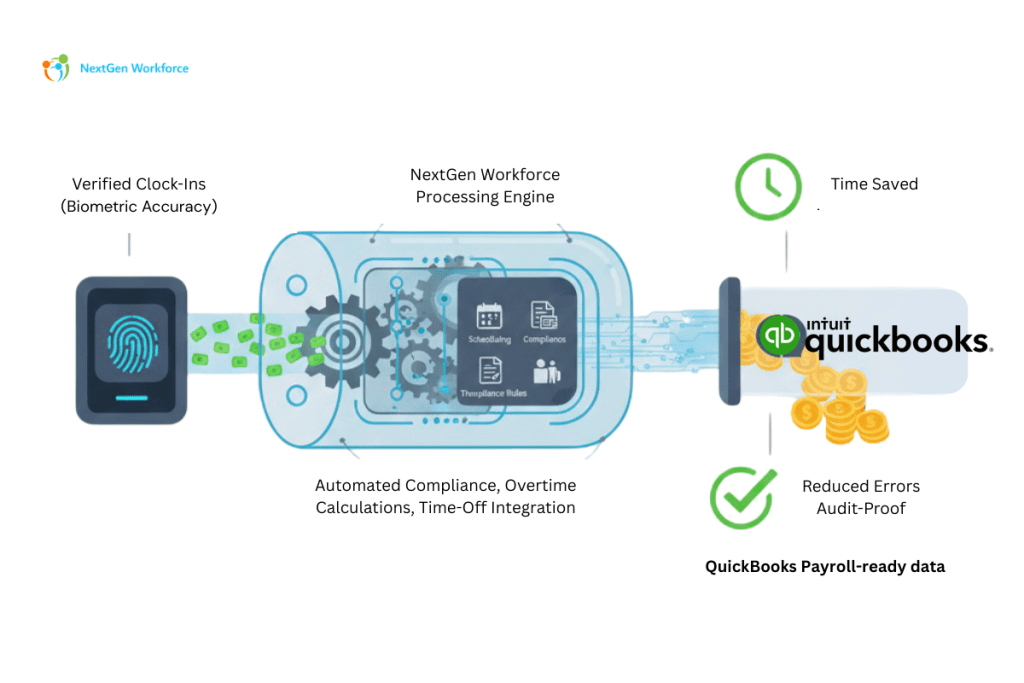
Advantages of Integrating Biometric Timeclocks with QuickBooks